A waterfall effect countertop can turn a conventional island into an architectural piece, but Extending the stone to the ground only compensates when that vertical surface contributes something to the project: vein continuity, better reading from the living room, side protection or a cleaner composition. If the side is barely visible or it affects the budget and use too much, a good conventional auction may be a better decision.
The result also depends on aspects that a finished photograph does not show.: the cutting of the table, the position of the grain, the meeting between pieces, the condition of the pavement and the precision of the assembly. At Marbres Barcelona we address these details as part of the design of our custom kitchen countertops, why the cascade is decided before cutting the material, not during installation.
What really is a waterfall effect countertop?
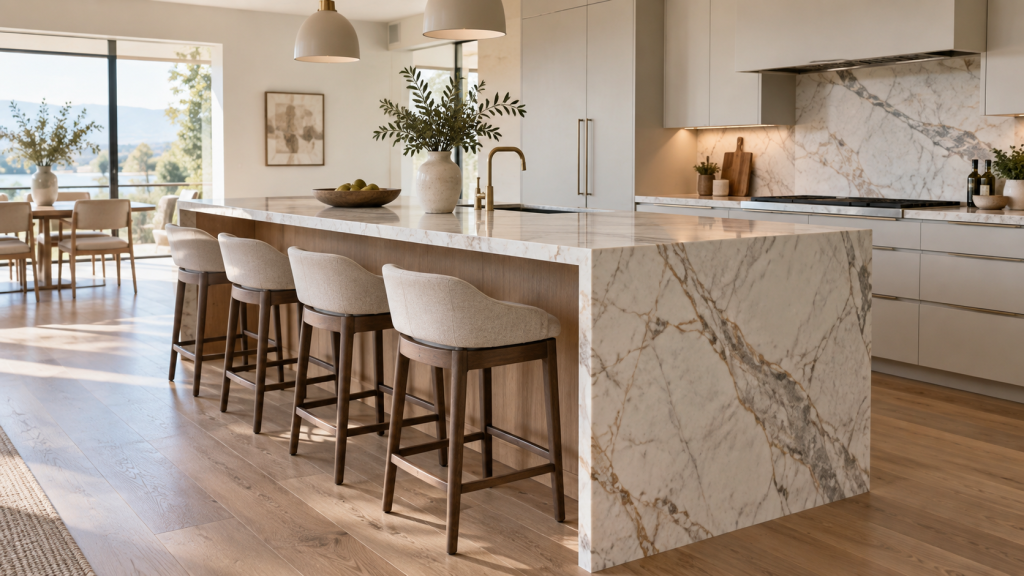
On a conventional countertop, The horizontal surface ends on the side of the furniture and leaves the side of the island or peninsula visible. On a waterfall effect countertop, the same material language continues vertically to the pavement, so that the stone seems to fold over the edge.
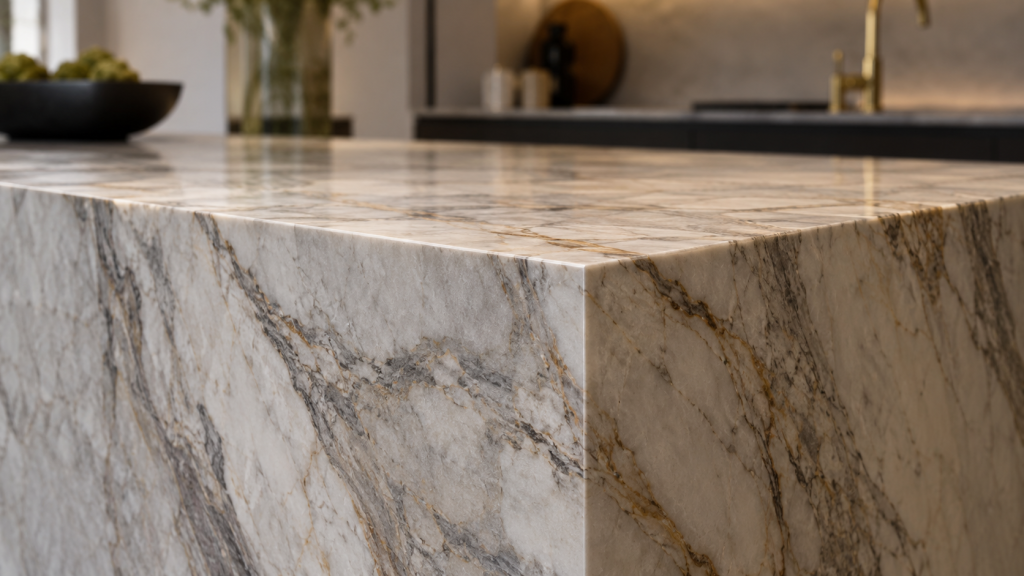
That doesn't mean the board physically bends.. Normally you work with a horizontal piece and another vertical piece that must be found very precisely.. When the design requires it, The change of plane can be resolved by miter meeting to achieve a clean edge and make the transition appear continuous.
The difficulty increases when the material has a very marked grain. On a uniform surface, small differences in position can go unnoticed; on a marble, a quartzite or any stone with a directional pattern, the side immediately reveals whether the exploded view has been designed as a set or as two independent pieces.
When is it worth carrying the stone to the ground?
The waterfall makes sense when it fulfills a function within the overall composition. It shouldn't be incorporated just because it appears in many inspirational kitchens: There are projects in which it completely transforms the island and others in which it adds material without really improving the result..
To decide, it is advisable to ask yourself where the countertop will be seen from., How much prominence will the island have and what does the vertical surface contribute?. The response is usually especially favorable in the following scenarios.
When the island is seen from the living room or from the entrance
In open kitchens, the end of an island can be permanently facing the dining room, the sofa or the entrance of the house. Then, the side is no longer a secondary part of the furniture and becomes part of the main image of the space.
Extending the material to the floor allows the island to be visually closed and prevents the countertop from appearing simply resting on a succession of modules.. The solution works especially well when you want the kitchen and living area to share a more architectural language and less similar to that of independent furniture..
When the stone has a vein that deserves to continue
A table with an expressive movement gains another dimension when the drawing can go from the horizontal to the vertical plane. The waterfall turns the vein into part of the island's geometry, making visible a surface that in a conventional countertop would be practically limited to the upper plane.
But here the previous work matters more than the choice of material itself.. The position of the cuts must be decided on the entire board, taking into account which part of the drawing will appear in each plane. In our guide on vein continuity in natural stone we explain why a good visual correspondence is projected from the exploded view.
When we want to protect a very exposed side
The end of an island located in a passage area receives friction, chair knocks, footwear and small everyday impacts. Covering it with the same material as the countertop can help protect the furniture and, at the same time, visually simplify the whole. In a family kitchen or with a lot of traffic, The waterfall may also have a practical reason.
When we look for an island with its own presence
In certain kitchens, the island is the element that organizes the entire space. If it has generous proportions and enough distance around, extending one or two sides can reinforce that condition. The stone stops being read as a finish and begins to define the volume.
This effect is more convincing when the rest of the kitchen maintains some restraint.. If there are already many materials, colors, decorative fronts and texture changes, adding another large surface of stone can generate the opposite effect and overload the whole.
When a waterfall countertop may not compensate
Just because a waterfall is technically possible does not mean it is necessary. The first case in which it is advisable to question it is when the side will barely be visible, for example because it is close to a wall, facing a secondary area or hidden by the distribution itself.
It must also be assessed what is lost by closing that end. May affect lateral access, to socket location, to certain end pieces of furniture or the feeling of lightness of a small island. Besides, Using more surface means greater material consumption and additional cutting work, adjustment and assembly.
| Situation | Waterfall? | Decision criterion |
|---|---|---|
| Island very visible from living room or dining room | Usually adds value | The side participates directly in the design of the space |
| Stone with protagonist vein | Especially interesting | Allows you to extend the drawing towards the vertical plane |
| Virtually hidden end | May be expendable | Additional material consumption will have little visual return |
| Small island or very compact kitchen | It is worth studying it | Excessive stone mass can make the volume heavier |
| Need for storage or facilities on the side | It must be resolved before | The vertical panel conditions access, records and some mechanisms |
That's why the appropriate comparison is not “waterfall versus nothing”. A well-resolved furniture side, a panel in another material or a cascade at a single end can offer a more balanced result than covering both sides per system.
The continuity of the grain can decide the entire result
In natural stone, the side must project at the same time as the upper surface. If a vein reaches the end of the island at a certain position, the vertical piece must visually start from that same path. Choosing two similar-looking fragments does not guarantee a convincing transition.
It must also be assumed that absolute continuity is not always possible.. Available table dimensions, cutouts for sink or plate, the meaning of the drawing and the use of the material determine the cutting. The reasonable goal is get a natural reading of the plane change, do not pursue an impossible match at any cost.
Miter meeting needs precision
The upper angle of the waterfall immediately attracts the eye. A well-executed meeting allows the apparent thickness and continuity of the surface to be kept clean.; one poorly planned makes the board become the protagonist element. The smoother or more veined the surface, the more visible any deviation is.
At Marbres Barcelona we work on measurement, preparation and installation as related phases precisely for this reason. The actual measurements of the furniture and space must be correctly transferred to the cut so that both pieces are as planned..
The pavement also enters the equation
Vertical panel ends against the floor, so it is not enough to measure the height of the furniture. The final pavement and its leveling must be considered, especially when the kitchen is still under construction and the countertop is designed before all the finishes are finished.
A small irregularity that would be irrelevant under a baseboard can become evident next to a rigid piece that reaches to the floor.. That is why it is advisable to coordinate furniture, floor and countertop before manufacturing the side.
What materials work best in a waterfall
There is no single suitable material. The choice must combine behavior, drawing and manufacturing possibilities. A spectacular stone can justify the side precisely because of its grain; another more uniform one can generate a sober composition where the protagonist is geometry.
Before deciding, it is advisable to observe a sufficiently large surface. A small sample allows you to evaluate color and finish, but it says little about how a drawing will behave when moving from the horizontal to the vertical plane..
Marble and marked vein stones
Materials with long grains or defined movements offer some of the most expressive results. The side allows you to show much more drawing and create a very recognizable transition. In exchange, require careful study of which areas of the table are intended for each piece and assume the maintenance characteristics of each stone.
Granite for a more visually solid waterfall
Granite can work very well when looking for strength and a natural aesthetic less dependent on a continuous grain.. There are discreet varieties and others with very pronounced movements., so it is not advisable to treat all pimples in the same way.. If the priority is a resistant surface for everyday use, we can value different granite countertops depending on the aspect and needs of the project.
Porcelain for contemporary compositions
Porcelain surfaces allow stone designs to be worked on, uniform tones and formats that fit especially well in kitchens with clean lines. The behavior of the drawing on the edge must be reviewed according to the collection and the manufacturing system, because not all plates are resolved in the same way.
We also work on projects where this aesthetic prevails. custom porcelain countertops, studying dimensions, meetings and finishing before defining the final parting.
A waterfall on one side or both??
It is not mandatory to close both ends of an island. In fact, A single waterfall is usually sufficient when only one of the sides has a true visual presence.. It is common, For example, that one end faces the living room and the other is used for circulation, storage or lighter finishing.
Two waterfalls create a more resounding and symmetrical volume. They can work very well in a large central island, but they use more material and increase the visual weight. In more contained spaces, An asymmetric solution may be more interesting and allow the stone to take center stage without turning the island into an excessively closed block..
The stool area should also be studied. The waterfall has to coexist with the flight of the bar, legroom and tours around the island. Resolving aesthetics first and then adapting use often leads to unnecessary compromises..
What to check before ordering a waterfall effect countertop
The decision should be made before manufacturing the countertop. Changing your mind when the horizontal surface is already cut may prevent you from maintaining the planned drawing or require a new piece.. Material, dimensions and parts must be studied as the same project.
Before approving it, It is worth reviewing both what will be seen and what will be conditioned by the vertical panel. A simple check can avoid decisions that are difficult to correct later.
- From which areas of the home will each side of the island be visible?.
- If you are interested in a waterfall at one end or at both ends.
- How will the grain continue between the surface and the vertical piece.
- Where exactly will the union between both pieces be?.
- If the final pavement is installed and correctly leveled.
- If there are plugs, records, storage or facilities on that side.
- How the waterfall will affect stools and circulation around the island.
- How much additional material does the chosen cutting require?.
These questions allow you to decide the cascade by its real consequences, not only because of its appearance in a photograph. They also help to compare budgets with more criteria, since two apparently identical proposals can contemplate very different dismantling and assembly solutions..
Frequently asked questions about waterfall effect countertops
Doubts usually appear when we go from the aesthetic idea to the real project.. Most of them are resolved by jointly studying material, distribution and manufacturing, because the same solution can be appropriate in one kitchen and unnecessary in another.
These are some of the issues that should be clear before incorporating a stone side to the ground..
Is a waterfall effect countertop always more expensive??
In front of the same countertop without stone side, usually requires more material and more manufacturing and installation work. The specific difference depends on the dimensions, of the selected material, of the use of the tables and the complexity of the matches. That is why it is more useful to compare the complete project than to apply a generic supplement.
Does the grain have to match perfectly?
A mathematical coincidence is not always possible, especially in natural stone. The important thing is that the drawing maintains a consistent direction and visual transition. The very nature of the table, cuts and machining introduce conditions that must be taken into account from the cutting.
Can you make a waterfall on one side only??
Yeah, and in many projects it is the most logical option. If only one end is exposed towards the day area, concentrating the stone there can offer practically the entire visual effect without unnecessarily closing the other side.
Is it worth it if the countertop does not have a marked grain??
You may deserve it. In more uniform materials, the appeal comes less from the continuity of the drawing and more from the geometry of the volume. A smooth waterfall can reinforce a minimalist kitchen, as long as the proportions of the island and the space match.
A good waterfall must have a reason for being
Extending the stone to the floor makes sense when it improves the way the kitchen is perceived.: finishes a very visible side, continues an interesting vein, protect an exposed end or turn the island into the element that articulates an open kitchen. When none of these reasons exist, adding more stone does not guarantee a better design.
At Marbres Barcelona we can study the countertop from the choice of material and measurement to the cutting., manufacturing and assembly. If you are considering an island with a waterfall effect, It is advisable to decide the side at the same time as the countertop, so you provide, joints and grain can be resolved before the first cut.
