The continuity of the grain in a natural stone countertop is not achieved by correcting the pieces during assembly: It is decided before making the first cut. Choosing the table, the cutting, The position of the joints and the relationship between horizontal and vertical surfaces determine whether the stone pattern flows naturally or is interrupted in the most visible points..
What it really means to achieve grain continuity
When we talk about vein continuity we refer to maintain a coherent visual reading between adjacent pieces. A grain that runs along the countertop can extend to another section, turn towards the side of an island or ascend the wall covering without the change of piece abruptly breaking its path.
This is especially important in marble., quartzites and other stones with marked directional patterns. In materials with a more homogeneous or granular appearance, the exact position of each cut may go unnoticed. The greater the prominence of the grain, The most important thing is to plan your route.
Besides, Continuity does not mean that two pieces should look like a repeated photograph. Natural stone presents variations specific to each slab and the objective is make those particularities work in favor of the design, respecting the character of the material.
The result begins when choosing the stone table
Before deciding where each piece will go, it is advisable to look at the complete table, not just a small sample. Color allows you to discard or select materials, but to project a continuous vein we also need to know the address, actual intensity and distribution of the drawing. A dominant vein can become the common thread of the entire kitchen.
In our natural stone selection We work with materials whose uniqueness is part of the project. Precisely because each table is different, the distribution of the pieces must adapt to the stone available and not consider ourselves as if we were working with a completely repeatable pattern.
You must also check if the dimensions of the table allow you to obtain all the elements while maintaining the desired orientation.. Sometimes a layout designed solely to make the most of the material conflicts with visual continuity.. Prioritizing the vein may require modifying the cutting or having more stone surface, something that should be evaluated before approving the project.
The quartering must be designed before cutting
Once the measurements of the kitchen and the characteristics of the table are known, one of the most important moments arrives: decide where each element is cut. In our custom kitchen countertops we work the measurement, manufacturing and installation as parts of the same process because Good continuity depends on relating measurements and drawing of the stone.
The breakdown must consider from the beginning the length of each section, the meetings, The sink, the cooking plate, corners and any vertical pieces. At Marbres Barcelona we also have a Proliner measurement system and cutting technology aimed at achieving a precise fit.. The more accurate the information prior to machining is, greater control exists over the final result.
Before approving the cut, it is advisable to especially review:
- What area of the table will each section of countertop occupy?;
- in which direction the dominant veins advance;
- where will the inevitable meetings be;
- what drawing will appear around the sink and hob;
- how the stone will continue on the sides, cascades or coatings;
- What areas of the table do we want to reserve for their visual interest?.
This approach allows you to make decisions with intention. An attractive grain loses strength if it ends in a poorly located joint, while a studied distribution can turn a characteristic of the stone into the element that visually organizes the entire kitchen.
Where it is most difficult to maintain continuity
A straight countertop made from a single piece poses few difficulties from a visual point of view.. The challenge appears when geometry forces it to be divided. Together, Corners and plane changes are the points where continuity is really put to the test..
That is why not all areas should receive exactly the same attention.. A joint located under a piece of furniture can be secondary, while the side of an island visible from the living room becomes a permanent focus. The priority should be how the finished kitchen will be perceived..
Joints between two sections of countertop
When two pieces have to meet, The first thing is to decide where we want the vein to cross. If both come from nearby areas of the same table and are oriented correctly, the movement of the stone can cross the joint in a much more natural way.
The board itself will continue to exist and must be executed precisely, but its visual impact decreases when I draw, tonality and direction maintain a logical relationship. Trying to hide a joint without first studying the pattern usually gives worse results. than consciously integrating it into the design.
Islands with cascade side
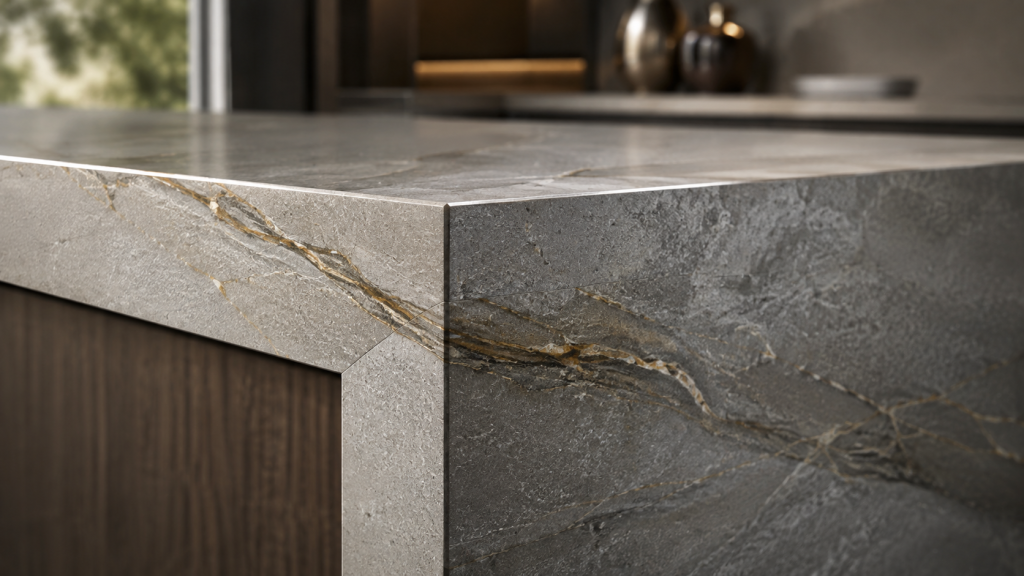
The so-called waterfall carries the same material from the horizontal surface to the ground through a vertical panel. It is one of the places where a well-planned grain has the greatest effect., why the stone may seem to fold over the edge of the island.
To get it, surface and lateral must be considered together from the cutting. A mitered meeting allows you to resolve the change of plane with a clean edge, but the position of both pieces on the board must compensate for the material that disappears during cutting and machining. It is not enough to choose two similar areas: you have to project where they will be exactly.
Countertop and wall covering
When the same stone continues from the countertop to the kitchen front, the visual relationship changes. The vertical surface is very exposed to the eye and an interruption of the grain may be more evident than on the horizontal plane.
In this case you can look for an upward continuation, a balanced composition between both surfaces or even reserve a particularly expressive area of the board for the front. The best solution depends on the available drawing and elements such as tall furniture, windows, plugs or hood.
Grain continuity and bookmatch are not the same
It is common to use both concepts as synonyms., but they respond to different compositions. In a vein continuity or vein matching, The goal is for the drawing to progress from one piece to the next. with a coherent visual direction.
He bookmatch, instead, faces two consecutive tables or surfaces as if we were opening the pages of a book. The result is a mirrored drawing, usually symmetrical. The bookmatch seeks a mirror effect; continuity seeks to prolong movement.
That's why a bookmatch can be spectacular on a wall, a large front or central composition, but it is not automatically the best solution for a waterfall. When we want a vein to go from the top of an island to the side, normally it is interesting that it appears to continue its journey around the angle.
Why perfect continuity is not always possible
Natural stone imposes limits that are part of its own nature. table dimensions, the position of a specific vein, The necessary cuts and the amount of material available determine the cutting. Continuity must be evaluated on the real table and on the real measurements of the project.
Besides, cutting and machining involves removing a small strip of material. This is especially important in miter joints or points where a very fine grain must cross from one piece to another.. Compelling visual continuity is more important than chasing an impossible geometric coincidence.
Among the factors that can limit it are:
- a table too small to maintain the intended orientation;
- sink or plate cutouts located on a main vein;
- the need to introduce several joints;
- pronounced changes in the natural pattern of the stone;
- lack of consecutive tables when the project requires multiple parts;
- a use of the material incompatible with the desired pattern.
Detecting these limitations before manufacturing allows you to decide what is prioritized. Sometimes it will be preferable to reserve the best continuity for the island and accept a more discreet transition in a secondary area. Good planning also consists of knowing where it is worth concentrating the effect.
What should be checked before approving a marbled countertop
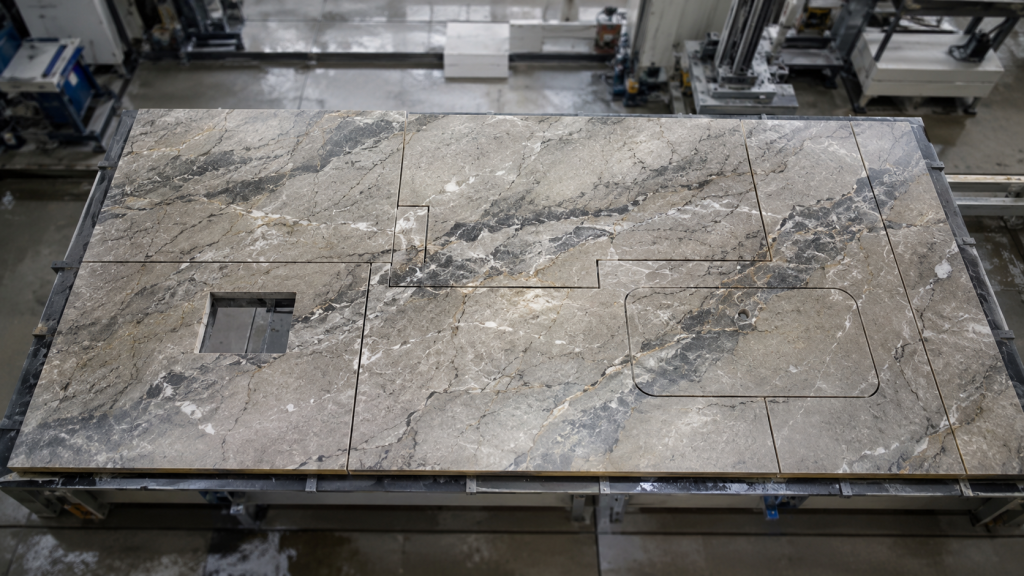
If continuity has weight in kitchen design, It is not advisable to limit the choice to the name of the marble or the general tone. Whenever possible, it is useful evaluate the complete table and understand how the project will be distributed over it.
In our showroom de Barcelona we can address the choice of materials within the entire project. View surfaces, finishes and grain movements on a larger scale helps make decisions that a small sample cannot anticipate.
Before approving the work, it is worth asking these questions:
- What will be the most visible veins once the countertop is installed??
- Where are the meetings scheduled??
- what will happen to the grain in the corners?
- How will the drawing continue if there is a waterfall?
- Will stone also be used on the kitchen front??
- Is there enough material to maintain the chosen cutting?
These questions allow us to talk about the result before starting manufacturing., when it is still possible to rearrange the pieces. Grain continuity is better controlled on the plane and on the board than in front of an already installed countertop.
A good grain is designed from the board to the assembly
Achieving a visually continuous natural stone countertop requires coordinating material, measures, dismantling, cutting and placement. The quality of the result is in how all those decisions are related.: an extraordinary table alone does not guarantee a coherent composition.
At Marbres Barcelona we work on personalized projects from the selection of the material to its manufacturing and installation.. When the grain plays a leading role, we treat it as part of the design and not as a detail that can be resolved at the end. Choose well where you start, Where it continues and where it ends allows you to take advantage of what makes each natural stone unique..
