An outdoor kitchen countertop has to respond to conditions that barely exist inside the home.: continuous solar radiation, rain, temperature changes, humidity and environmental dirt, besides the heat, stains and bumps from cooking. Choosing it well requires looking beyond the color or finish and checking how the material will behave after several years outdoors..
on a terrace, a garden or an attic, The external resistance must be valued as a whole. The chosen surface matters, but also their songs, gaps, together, support and installation system. At Marbres Barcelona we work custom kitchen countertops taking into account the real use that each project will have, something especially relevant when the kitchen is exposed to the weather.
What changes when the kitchen is really outdoors
An indoor kitchen works in a relatively stable environment. Instead, an outdoor countertop can heat up for hours in the sun and cool down quickly when the temperature drops or in a storm. Rainwater is added to this thermal variation., ultraviolet rays and, in areas close to the sea, an environment with a greater presence of salt and humidity.
Besides, An outdoor kitchen usually concentrates demanding uses: barbecues, irons, ovens, oils, vino, citrus or sauces. That's why, A material that works correctly inside the home does not have to be suitable outside.. Before deciding, it is advisable to expressly check that the manufacturer contemplates this application and know the maintenance needs of the surface..
- Direct or partial exposure to UV rays.
- Rain and water accumulated on the surface.
- Temperature changes between day and night.
- Heat generated by barbecues, irons or ovens.
- Fat, acidic foods, wine and cleaning products.
- blows, scratches and pressure around gaps and edges.
- Environmental humidity and salinity in locations near the sea.
The intensity of these factors changes greatly between a completely open kitchen and one located under a porch.. The greater the exposure, Less margin should be left for materials or solutions designed mainly for interiors..
What a good countertop for an outdoor kitchen should do
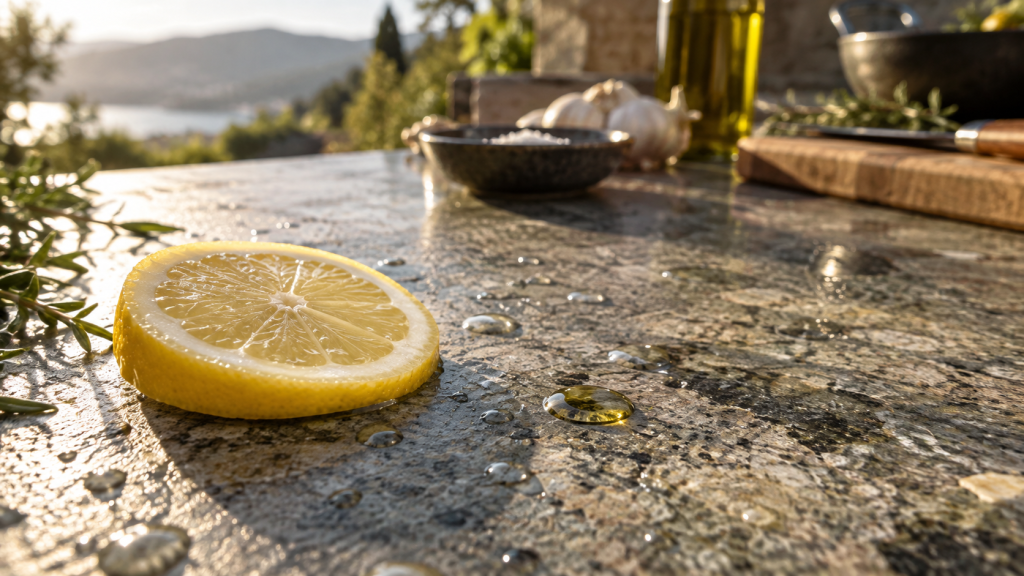
There is no single characteristic that determines whether a countertop is suitable for outdoors.. Good behavior comes from the combination of stability, low absorption, resistance and proper installation. These are the aspects that should be reviewed before choosing material.
It is also interesting to distinguish between generic statements and specific benefits.. Just because a surface is hard or heat resistant does not automatically mean it will withstand years of sun exposure.. For an outdoor project, The technical sheet and instructions for outdoor use have more value than a broad commercial description.
Stability against sun and UV rays
Ultraviolet radiation can affect pigments, resins and certain surface treatments. An outdoor countertop needs maintain reasonably stable color and finish under prolonged sun exposure, especially when one part is in full sun and another usually remains in shadow.
It is also worth thinking about comfort. Very dark shades can reach high surface temperatures during hours of maximum sunshine. A UV-resistant color may still be very hot to the touch., so orientation, shade and tone must be decided together.
Low water absorption and easy stain control
Rain should not cause significant alterations or become a constant way for moisture to enter.. Surfaces with very low absorption have an advantage because reduce water penetration, oil and other liquids and tend to make cleaning easier.
In natural stone, the situation depends on the specific variety and its porosity. Some materials may benefit from periodic protective treatments. In those cases, maintenance is part of the choice of material and must be known before installing it, not when the first stain appears.
Stability against changes in temperature and heat sources
A countertop placed in the sun undergoes repeated thermal cycles. High temperatures around a barbecue or griddle can be added to them.. That is why it is interesting that the material has good behavior against thermal variations and that the assembly respects the specifications of each equipment.
Thermal resistance and thermal abuse are not the same either.. Even if a surface tolerates high temperatures, It is advisable to avoid unnecessarily concentrating extreme heat on edges, joints or mechanized areas. The safety and ventilation distances indicated by the barbecue or oven manufacturer must be part of the design..
Spots resistance, acidic foods and frequent cleaning
In an outdoor kitchen it is common to work with oil, tomato, vino, café, lemon or marinated. The countertop must allow for easy cleaning without turning each meal into a maintenance task.. Low porosity helps, although the chemical resistance of the material also matters.
Acidic foods deserve special attention in certain natural stones. On sensitive surfaces they may cause changes in gloss or marks.. The right countertop is the one that fits the level of care we are willing to take., not necessarily the one that offers the most striking aesthetics in a sample.
Mechanical resistance in edges, gaps and overhangs
The hardness of a complete board tells only part of the story. The most delicate spots are usually found around sinks, plates, integrated barbecues, corners and overhangs. The machining and supports must be designed to correctly distribute the loads.
This is especially relevant in large format materials and reduced thicknesses.. A high-performance surface can offer a long-lasting result, but needs a structure compatible with its thickness, geometry and dimensions. Material and installation must be considered as the same decision.
What materials work best in an outdoor kitchen
When the countertop is going to be permanently exposed, Granite and certain porcelain or sintered surfaces designed for outdoors are usually the first materials worth considering.. Both approaches can solve very different projects, from natural-looking kitchens to contemporary compositions with very clean lines.
That doesn't mean that any pimple, Any porcelain tile or any technical surface responds the same. The specific variety, the finish, the technical sheet and installation conditions continue to be decisive. This comparison serves as a starting point, not as a substitute for project study.
| Material | Exterior behavior | Strong point | What to check before choosing |
|---|---|---|---|
| Granite | Very favorable in suitable varieties | Natural stone, resistance and good thermal behavior | Porosity, finish, sealing and characteristics of the variety |
| Porcelain or sintered stone suitable for outdoors | Very favorable | Very low absorption and good external stability | Outdoor approval, thickness, edges and support |
| Ultra-compact surfaces specific for outdoors | Very favorable when the manufacturer indicates it | UV stability, low absorption and reduced maintenance | Model, finish, machining and assembly instructions |
| Marble and other calcareous stones | Possible, but more demanding as a work area | Natural aesthetics and aging with character | Stains, acids, acceptable finish and maintenance |
| Compact quartz with resins | Variable depending on product | Good behavior indoors | Express authorization from the manufacturer for outdoor exposure |
A common mistake is to decide only by families. Two surfaces grouped under a similar term may have different exterior specifications.. It is always worth confirming the exact model before closing the quote or manufacturing the parts.
You should also consider how each option ages.. A natural stone can develop small changes that are part of its appearance, while a technical surface usually seeks greater uniformity. Durability also has an aesthetic dimension: It matters how we want the kitchen to look in five or ten years.
Granite for exterior: a particularly resistant natural option
Granite has been used for years in applications subject to demanding conditions. For an outdoor kitchen, combines hardness, thermal resistance and the unrepeatable appearance of a natural stone. Besides, There are very different finishes and shades, which allows it to be integrated into both modern terraces and more rustic spaces..
Nevertheless, It is not advisable to consider all granites identical. The absorption, The finish and specific characteristics of each stone may vary. At Marbres Barcelona we work custom granite countertops y we value the stone within the complete project: use, design, mechanized, furniture and space conditions.
In an open kitchen, The surface finish also deserves attention.. A very shiny polish, A matte finish or a more marked texture offer different sensations and may respond differently to dirt., reflections or everyday use. Seeing the table or a physical sample helps you decide much more accurately. to choose only from a photograph.
Porcelain tiles and sintered surfaces: very interesting outdoor features
Porcelain and sintered surfaces have gained presence in outdoor kitchens due to their combination of technical performance and aesthetic variety.. When the product is indicated for that use, its low absorption and stability against weather conditions are especially useful on exposed countertops.
At Marbres Barcelona we have custom porcelain countertops and we work with different manufacturers and finishes. In this type of materials, Just as important as choosing the surface is correctly projecting the thickness, el canto y los huecos, sobre todo alrededor de fregaderos y elementos de cocción.
Dentro de este ámbito existen soluciones específicamente desarrolladas para soportar el exterior. Es el caso de superficies ultracompactas con prestaciones declaradas frente a radiación UV, humedad y cambios térmicos. También fabricamos custom-made Dekton encimeras. La ventaja de estas soluciones aparece cuando se aprovechan sus propiedades dentro de un diseño y una instalación bien resueltos, no simplemente por elegir una marca concreta.
Mármol y cuarzo compacto: materiales que requieren valorar mejor la exposición
El mármol puede utilizarse en numerosos proyectos exteriores, pero una encimera destinada a cocinar plantea exigencias específicas. Al ser una piedra calcárea, Acidic foods can alter its finish and certain liquids can leave marks if not maintained properly.. It can be an attractive choice when aging is accepted., but it is not the most carefree option for all users.
Something different happens with compact quartz surfaces.. Many work very well as interior countertops., but The presence of resins makes it essential to check if the manufacturer authorizes the specific product for continued sun exposure.. It is not advisable to automatically transfer to the outside the benefits that we know of an indoor kitchen..
This distinction avoids simplifications such as thinking that a material is always good or bad for an outdoor kitchen.. The correct question is whether that specific reference is prepared for the real conditions of the project., what maintenance it requires and what limitations its manufacturer establishes.
The installation is part of the resistance to rain and sun
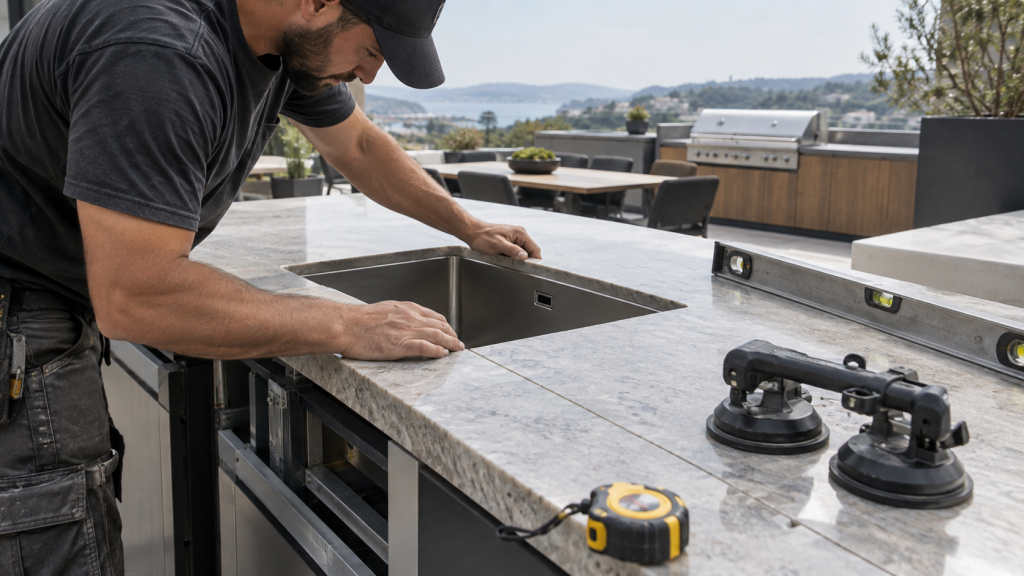
A high-performance board can cause problems if the construction project does not accompany it.. Outdoors, agua, Expansion and heat especially put the joints to the test, adhesives, seals and support points. That's why, manufacturing and assembly have a greater weight than in a purely decorative countertop.
At Marbres Barcelona we measure, manufacturing and installation of parts. This continuity allows study the encounters with sinks from the beginning, barbecues, paredes, pillars and furniture, instead of trying to solve them when the countertop is already manufactured.
Joints and seals prepared for outdoors
The joints must accept the expected environmental conditions and avoid areas where dirt or water accumulates.. A tight joint needs to be well executed, not simply be inconspicuous. The adhesive or sealant used must also be compatible with exterior exposure where applicable..
When disassembling requires joining several pieces, we work on solutions like our semi-invisible joints for countertops. In an outdoor kitchen, the approach of the joints must coordinate aesthetics, stability and maintenance.
Avoid points where stagnant water remains
Water should not remain trapped around bibs, sinks, encounters with walls or level changes. Clean design makes it easy to dry the countertop and simplifies cleaning. It is also advisable to carefully study the areas protected by appliances or permanent elements..
This does not mean that every work surface must have a noticeable slope.. A countertop needs to be comfortable for cooking. The important thing is to avoid depression, poor sealing and geometries that turn certain points into small water reservoirs.
Barbecues and appliances require their own study
A built-in barbecue generates heat and requires certain ventilation and separation conditions.. The countertop recess must be designed based on the actual model of the appliance and its technical documentation., not from an approximate measurement taken before choosing it.
The same thing happens with sinks., emphasis, outdoor refrigerators or plates. Providing technical sheets before manufacturing allows resolve gaps and supports with greater precision and reduce improvisations during assembly.
How to choose the countertop according to the type of outdoor kitchen
The best decision changes depending on location. A kitchen under a pergola on an urban terrace and another completely uncovered next to a pool They will not withstand the same amount of radiation, water or environmental dirt. Before comparing catalogs, it is advisable to classify the real degree of exposure.
It also matters how it is going to be cooked. A bar used occasionally to serve drinks requires less than a barbecue area, sink and frequent food preparation. The more intensive the use, It makes more sense to prioritize performance and ease of maintenance against delicate materials.
- Completely open kitchen: prioritize surfaces expressly suitable for outdoors, UV stable, low absorption and with a mounting designed to remain outdoors.
- Kitchen under porch or pergola: it's still an exterior; top protection reduces direct rain, but it does not eliminate radiation, humidity or temperature changes.
- Penthouse with a lot of sunshine: especially assess the stability of the color and the temperature that the surface can reach, especially in very dark tones.
- Area close to the sea: review the entire project, including hardware, structure, adhesives and appliances, because the saline atmosphere especially affects metallic components.
- Heavy-duty barbecue area: study thermal resistance, gaps, safety distances and supports before manufacturing the countertop.
This classification usually shortens the choice quite a bit. First we discard the solutions that do not fit technically and then we choose among those that do respond to the use. So, design and color are decided within a group of suitable materials, instead of trying to adapt afterwards a purely aesthetic choice.
Common questions before installing an outdoor countertop
Doubts usually focus on the same point: How much can an outdoor kitchen be like an indoor one?. Visually they can share design, but technically they must be resolved differently when there is permanent exposure.
These answers serve as initial guidance. Even so, the exact location, The chosen material and the kitchen equipment can change the recommended solution, especially in projects with integrated barbecues, overhangs or large formats.
What is the best material for an outdoor kitchen countertop??
There is no universal one. For a demanding exhibition, granite and porcelain surfaces, Sintered or ultra-compact specifically suitable for outdoors are especially interesting options.. The final choice will depend on aesthetics, maintenance, budget, project design and conditions.
Can an outdoor countertop be left uncovered all year round??
Yeah, as long as the material and installation are prepared for it. The external suitability must be checked on the concrete surface and on all the assembly elements., included sealed, adhesives, supports and equipment.
Does granite need maintenance outdoors??
It depends on the variety and its porosity. Some stones may require periodic stain protection. Not all pimples need exactly the same treatment, so it should be determined according to the chosen stone and the finish..
Can a dark countertop be installed in full sun??
It can be done if the material has adequate features for outdoors., but you have to consider the use. Dark colors absorb more radiation and can become noticeably warmer., something relevant in bars, preparation areas and frequently touched surfaces.
Is an indoor countertop suitable for a covered terrace??
It shouldn't be taken for granted. A cover reduces direct rain, but there may still be solar radiation, humedad y cambios térmicos. A covered terrace continues to be an outdoor environment, so it is worth checking the application supported by the manufacturer.
When there are doubts between two materials, Comparing your technical sheets together with the kitchen plan is usually much more useful than comparing only samples. The project context ends up deciding which feature is really important.
Choose thinking about how the kitchen will be in a few years
A well-planned outdoor kitchen should allow you to cook and gather around it without constantly having to protect the countertop.. Granite, Porcelain tiles and certain sintered surfaces offer very solvent solutions when chosen and installed for that use.; Other materials can work if you know and accept their care.
At Marbres Barcelona we have more than 35 years of experience in custom countertops and we work from advice and measurement to manufacturing and installation. If you are planning an outdoor kitchen, the most useful thing is to study the material together with the exposition, the appliances and the final design. That complete vision allows you to choose a countertop that fits on the first day and continues to make sense after many seasons in the sun and in the rain..
