Yeah, In many cases it is possible change only the kitchen countertop and keep the existing furniture. It is a much more limited intervention than a comprehensive renovation and can transform both the aesthetics and the work area.. The condition is that the lower modules are in good condition, correctly leveled and adequate to support the new surface.
The decisive point is not whether the kitchen is more or less old, sino the actual state of the structure on which the countertop will rest. Before manufacturing the new piece, it is advisable to check the furniture, the measures, encounters with walls and elements such as the sink or hob. A prior check avoids discovering incompatibilities when the old countertop has already been dismantled.
When can you change the countertop without changing the furniture??
Preserving furniture makes sense when the hulls of the furniture remain firm, dry and well established. The doors may be out of fashion or have superficial wear without requiring you to replace the entire kitchen.. What really matters when installing a new countertop is the stability of the lower modules.
You must also check the leveling. A natural stone surface, quartz or porcelain tile needs stable and properly prepared support. If there are significant differences in level between modules, deformations, swelling from moisture or moving parts, These problems will have to be corrected before installing the new countertop..
For reference, It is worth reviewing these points especially before deciding.:
- Module status: no humidity, breaks or deteriorated chipboard.
- Leveling: the furniture must form a regular and stable base.
- Fixings: The modules must be correctly attached to each other and to the wall when applicable.
- Distribution: You have to check if the plate is maintained, the sink and its current positions.
- Encounters: paredes, columns, sides and corners must be taken into account in the new measurement.
If these conditions are met, There is no technical reason to replace furniture that still works well.. At Marbres Barcelona we can propose a new surface adjusted to the existing space through our service. custom countertops in Barcelona, from measurement to manufacturing and placement.
What to check before removing the old countertop
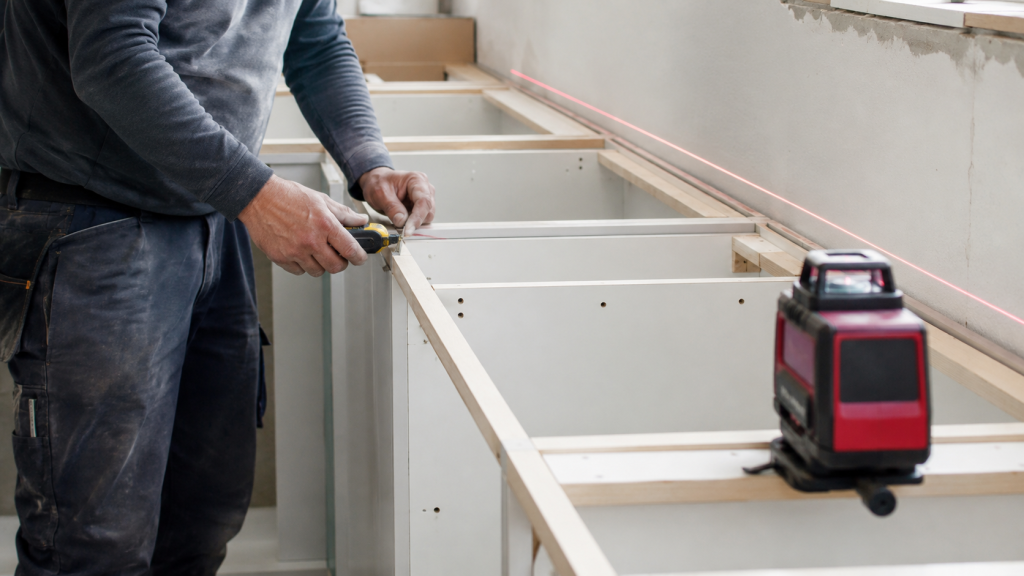
The new countertop should not be manufactured based solely on the length and depth of the previous piece.. A professional measurement should consider the space as it actually exists: possible misalignment of the walls, corners that do not form exactly 90 degrees, pillars, auctions and meetings between different sections.
This detail becomes especially important when working with materials that are previously machined in the workshop.. Sink and hob recesses need precise positioning and dimensions, as well as possible tap holes, integrated dispensers or plugs.
It is also advisable to decide before the change which elements will be kept. Keeping the same sink and hob can simplify the project if both are in good condition, but it does not mean that your previous clippings should be copied without checking them. The new material, The type of installation and the finish chosen can modify the technical solution.
For this reason, The measurement phase is more important than it seems. In our article on measuring to install a countertop We explain why a few millimeters can affect the final fit, especially in kitchens with several sections or irregular walls.
How to change a countertop while preserving the existing kitchen
The process begins with the evaluation and measurement of the space. Then the material is defined, the thickness, the finish of the edges and the position of the machining. The countertop is manufactured to fit the kitchen, not the opposite, something especially useful when preserving furniture that has been installed for years.
When it comes time to set up, the elements associated with the old surface must be removed. Depending on the kitchen, This may involve disassembling the sink., taps, plate and other accessories, in addition to removing silicones, caps or fixings. The objective is to free the countertop without damaging the modules that are going to be kept..
- Check the measurements and condition of existing furniture.
- Define material, design, songs, sink and plate.
- Manufacture and machine the parts according to the project measurements.
- Dismantle the elements connected to the old countertop.
- Remove the existing surface and prepare the supports.
- To place, level and adjust the new countertop.
- Seal encounters and reinstall corresponding items.
This approach allows limit the intervention to the area that really needs to be renewed. Nevertheless, Changing a countertop does not necessarily mean doing purely decorative work.: water connections, electricity or gas associated with certain equipment must be handled by the appropriate professionals when necessary.
Sink, plate and front: the elements that most condition the change
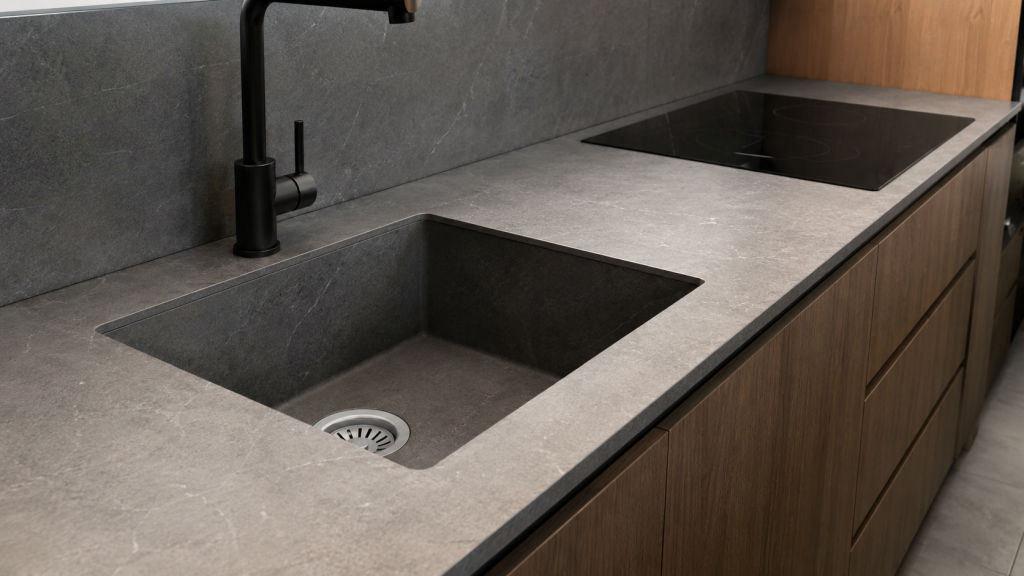
One of the common mistakes is to think only about the horizontal surface. Actually, the relationship between countertop, sink, plate and wall determine a good part of the project. If any of these elements change position or size, The new part will have to be manufactured taking into account that modification.
The sink offers several possibilities. Can be installed on the countertop, under her, flush or even consider an integrated solution, depending on material and design. If the change is used to renew this area, It is worth deciding before machining. We have gathered the particularities of this type of solution in our guide to countertops with integrated sink.
The hob also requires attention. Not all plates have the same recess dimensions, even when outwardly they appear similar. If the appliance is replaced at the same time as the hob, It is best to have the exact specifications of the new model in advance..
The front or dashboard can generate another decision. When the old countertop incorporates a trim, a cladding of the same material or finishes against existing tiles, You have to plan how the new surface will end up against the wall. Sometimes the coating can be preserved; In other projects it makes sense to renew it to achieve a cleaner meeting.
What material to choose if you keep the kitchen furniture
Keeping the furniture does not require you to repeat the material of the previous countertop. In fact, change allows update the behavior and appearance of the kitchen without altering its layout. The choice should be made according to daily use, the maintenance you want to assume, the design of the furniture and the characteristics of each surface.
Granite continues to be an interesting option when looking for natural stone and resistance for a highly used work area.. Quartz provides a wide variety of finishes, while porcelain surfaces allow you to work with contemporary proposals and features suitable for everyday use.. There is no universally best material for all kitchens.; It is advisable to choose it depending on the specific project.
In the case of the porcelain countertops, we work with surfaces aimed at demanding use and available in numerous finishes. We can also evaluate quartz alternatives like ours Silestone countertops, according to the functional and aesthetic needs of each kitchen.
Another aspect that should be considered is the weight and geometry of the new surface.. The choice of material must be made together with the verification of the existing support, especially when the kitchen has old modules, large overhangs, barras, peninsulas or areas that require specific reinforcements.
When it is not worth changing just the countertop
Isolated replacement is no longer a good solution when the furniture has structural problems. If the modules are swollen due to humidity, deformed or poorly fixed, Installing a new countertop on top does not correct the underlying problem. In these circumstances it is more reasonable to repair or replace the affected elements first..
Nor does it always pay to preserve the layout when the real objective is to transform the functionality of the kitchen.. If you want to move the sink to another wall, profoundly modify the cooking zone, create an island or rearrange modules, The project already exceeds a simple surface replacement and it is advisable to study it globally.
There are also intermediate situations. It may happen that almost all the furniture is in good condition and only one or two modules need adjustment or reinforcement. In these cases it is not necessary to give up the entire kitchen.: A prior assessment allows us to distinguish between a specific correction and a complete reform.
That's why, before deciding on appearance or age, interested in physically checking the support. A kitchen that has been used for years but is well preserved can be perfectly suitable for receiving a new countertop.; An apparently recent kitchen may have humidity or poor leveling that will have to be resolved first..
Changing the countertop makes sense when the base deserves to be preserved
If the furniture is still solid and the layout works, Renewing only the countertop allows you to intervene exactly where it is needed. The result can significantly modify the perception of the kitchen and, at the same time, avoid removing furniture that still correctly fulfills its function.
The difference between a simple change and a problematic one is usually in what is checked before manufacturing: leveling, measures, supports, sink, plate and encounters with the walls. At Marbres Barcelona we address the process from measurement to manufacturing and installation, so that The new countertop fits the existing kitchen precisely and the chosen material responds to the use it will receive.
