A countertop with integrated sink creates a continuous water area, personalized and visually clean. However, The result depends on both the material and the design and manufacturing precision.: earrings, unions, Basin depth and drain accessibility must be resolved before cutting surface.
At Marbres Barcelona we design and produce custom countertops in Barcelona, adapting each project to the available space, to the actual use of the kitchen and the desired finish. This planning allows you to assess whether an integrated sink is appropriate, one under counter or a flush installation.
What really is a countertop with integrated sink?
On a countertop with integrated sink, the bucket keeps the same material and aesthetic language as the work surface. The transition remains at the same level, without the characteristic top edge of a conventional sink, so the water area is perceived as part of the complex.
It is worth clarifying that “integrated” does not always mean that the countertop and sink have been obtained from a single solid piece.. In plate materials, like certain porcelain surfaces, the bucket is built using cut pieces, machined and assembled with great precision. When the unions are well executed, They remain discreet and allow the continuity of the design to be preserved.
There are also systems specifically developed to combine the bucket with a surface from the same collection.. The choice between a prefabricated solution and a custom-made solution will depend on the material, the dimensions, the color, the type of song and the level of customization requested.
How to make a custom built-in sink
Manufacturing begins before working the plate. First we define the position of the water zone, the measurements of the bucket, the location of the faucet and the relationship with the lower furniture. Good design must work inside and out: It is not enough for the sink to have a clean appearance if it then interferes with drawers, siphons, crushers or waste classification systems.
Once the final measures have been taken, the cutting is prepared. The material is cut and machined with suitable equipment to obtain regular edges, precise meetings and necessary holes. The accuracy of the cut determines the quality of the joints and the durability of the assembly, especially in corners, plane changes and areas close to the drain.
Basin design and slope calculation
The bucket can adopt different widths and depths, although its proportions must respond to everyday use. A bucket that is too small limits the washing of trays and pots; An excessively deep one can be uncomfortable and take away from the furniture's useful space.. Ergonomics should be decided along with aesthetics.
The bottom needs a sufficient slope to guide the water towards the drain. This inclination must be uniform and compatible with the design of the base. If only a completely flat appearance is prioritized, There may be small accumulations of water that require drying the bucket more frequently..
Court, assembly and sealing of parts
In sinks made from plates, The walls and bottom are assembled to form a stable bucket. The encounters can be resolved with different techniques depending on the material and design. Joints must minimize visibility without compromising tightness, since they will be subjected to humidity daily, temperature changes and cleaning products.
The adhesive, sealing and bottom reinforcement are selected based on the surface used. Exposed edges and interior corners are also checked., which must allow for reasonable cleaning. Extremely tight angles can create a very geometric image., but require more attention during maintenance.
Proof, transportation and installation in the kitchen
Before finishing the work, measurements are checked, meetings and evacuation. The countertop and basin must arrive prepared to coordinate with the furniture, plumbing and appliances. The installation is part of the technical result: Incorrect leveling can alter the drainage intended during manufacturing.
On site the pieces are fixed, The necessary seals are made and the support points are checked. The drain connection must remain accessible for future interventions. Once the set is installed, It is advisable to check the water flow and remove any remains from the assembly with a product compatible with the surface..
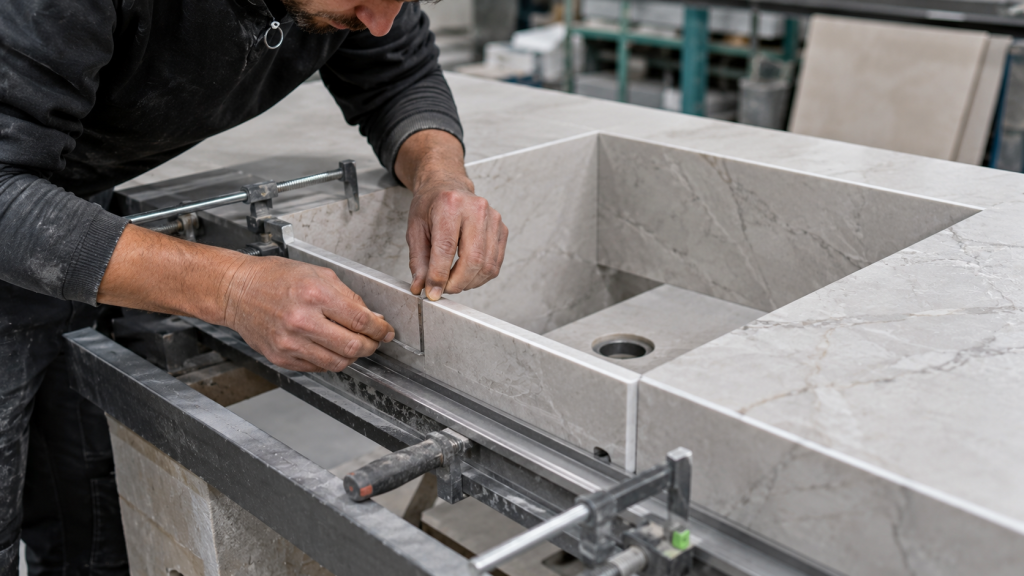
What materials allow the sink to be integrated
Not all surfaces are made or behave the same way. The choice must consider the finish, the use, maintenance and technical limitations of the material, in addition to the overall resistance of the countertop.
At Marbres Barcelona we work with natural stone, quartz and porcelain surfaces of different brands. Before proposing a solution, we value the available format, the thickness, the pattern of the piece and the possibility of reproducing the finish inside the tray.
Porcelain surfaces
Porcelain allows you to develop designs with great visual continuity and offers a wide variety of finishes inspired by stone., cement or uniform tones. Its low absorption and its behavior in everyday use make it a common alternative for this type of projects..
Manufacturing requires special care of the cuts, corners and edge protection. Surface strength does not eliminate the need for precise execution, because concentrated impacts on exposed edges can cause chipping. Among the available options, we can study projects with custom-made Dekton encimeras and other sintered or porcelain surfaces.
Compact quartz and coordinated systems
Quartz surfaces offer homogeneous colors and collections that facilitate coordination between countertop and basin. Some manufacturers have models designed to integrate with their own finishes., which helps to achieve a very smooth transition.
Direct exposure to containers recently removed from the fire should be avoided and trivets should be used.. It is also necessary to follow the manufacturer's specific recommendations on chemicals.. In our selection of Silestone countertops we can value colors, formats and solutions compatible with the water area.
Natural stone
Granite and certain natural stones allow you to create sinks with a unique presence. Each piece retains its own variations in tone and grain, hence the cutting must be planned to maintain a balanced composition. The result can fit both in contemporary kitchens and in more artisanal projects..
porosity, Acid response and sealing needs change depending on the stone. The marble, For example, requires special caution with lemon, vinegar and aggressive anti-limescale cleaners. Granite usually tolerates intensive use better, although it also requires a specific evaluation of the finish and the joints.
Advantages of integrating the sink into the countertop
The main attraction is continuity. The countertop, the bucket and, if desired, The drainer can share color and texture. The water area stops seeming like an added element and integrates into the kitchen architecture, something especially noticeable in islands and spaces open to the living room.
Superficial cleaning is also more direct. As there is no edge resting on the countertop, crumbs and water can be conducted into the bucket with a cloth. In our guide to advantages of integrated sinks we develop this relationship between continuity, hygiene and contemporary design.
Custom manufacturing allows the bucket to be adjusted to the needs of the project. Among the possible decisions are:
- A large bucket for washing bulky utensils.
- Two breasts to separate tasks.
- A drainer machined into the surface itself.
- A lid of the same material to partially hide the bucket.
- The location of the faucet, the dispenser and other accessories.
These options provide freedom, but they must be selected judiciously. The more encounters and accessories the design incorporates, the greater the manufacturing and cleaning demands. A simple composition usually ages better and makes daily use easier..
Aspects that should be evaluated before choosing it
An integrated sink usually requires more design and construction work than a conventional bowl.. This can have an impact on the budget and production deadlines.. You should not only compare the price of the sink, but the complete machining cost, assembly, reinforcement and installation.
You also have to think about a possible repair. A freestanding sink can usually be replaced without changing the countertop, while a fully integrated bucket is part of the set. Según el sistema utilizado, una intervención futura puede exigir un trabajo especializado o afectar a varias piezas.
Las esquinas interiores merecen atención. Los diseños muy rectos proporcionan una estética depurada, pero pueden retener más residuos que una cubeta de radios suaves. Before deciding, recomendamos comparar esta solución con las alternativas de undermount sink, flush or countertop.
Cómo limpiar y mantener un fregadero integrado
El mantenimiento diario debe adaptarse al material, aunque existe una pauta común: retirar los restos, limpiar con agua templada y jabón neutro, rinse and dry. El secado evita que la cal se acumule en el fondo y alrededor del desagüe, sobre todo en viviendas con agua dura.
Una bayeta suave suele ser suficiente para la limpieza habitual. No conviene dejar estropajos metálicos, utensilios oxidados ni recipientes húmedos durante periodos prolongados. Aunque la superficie sea resistente, estos objetos pueden producir marcas, depósitos o manchas externas difíciles de eliminar.
Limpieza diaria y manchas habituales
Las salpicaduras de aceite, café o salsas deben retirarse cuanto antes. Para la mayoría de superficies, un limpiador de pH neutro permite mantener el acabado sin dejar residuos. La frecuencia y la suavidad funcionan mejor que una limpieza agresiva ocasional.
Los depósitos de cal requieren un tratamiento compatible con el material. Nunca debe aplicarse un antical ácido de forma indiscriminada, especialmente sobre mármol y otras piedras sensibles. Antes de usar un producto nuevo, You have to consult the manufacturer's instructions or test it in an inconspicuous area.
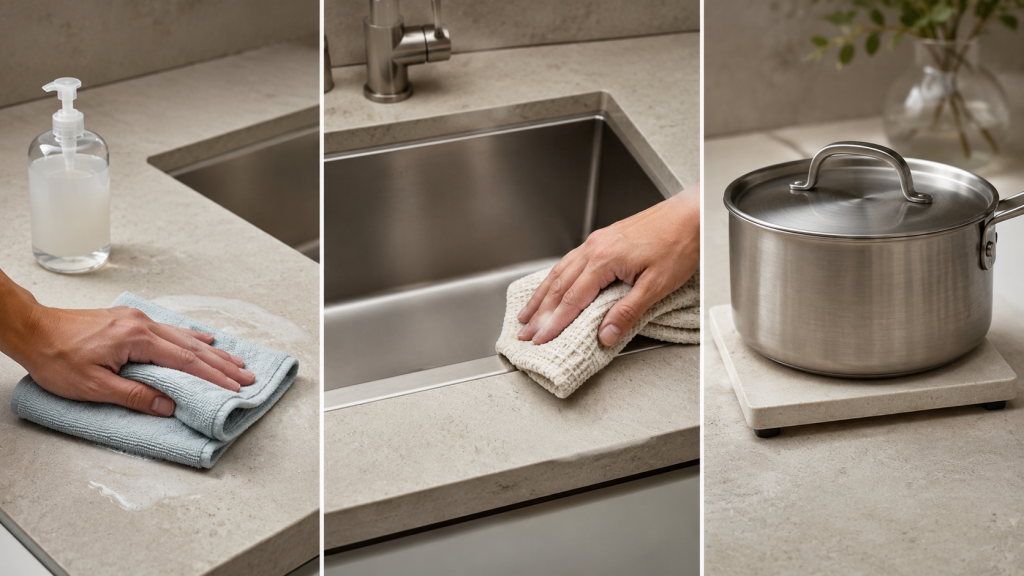
Products and habits to avoid
Concentrated bleach, the plungers, Oven cleaners and chemical mixtures can alter resins, adhesives, sealants or finishes. The most delicate point is not always the plate, but the union between the different parts. For that reason, no strong product should remain on the surface longer than indicated.
It is also advisable to avoid sudden thermal changes. Pots should not be supported, very hot trays or coffee pots directly on the counter or bottom of the sink. A protector reduces the risk of thermal shock and avoids concentrating heat in one point.
Joint review, drain and seals
During cleaning it is useful to observe if color changes appear, cracks or separations in the joints. A small alteration does not necessarily imply a structural problem, but Checking it soon allows you to avoid leaks and damage to the lower furniture..
The drain and the overflow, when it exists, must be kept clear. It is not advisable to dismantle adhered or sealed parts without knowing the installation system. Faced with a persistent leak, an impact or a damaged seal, It is appropriate to request a professional review.
Integrated sink, under counter or flush: which one to choose
The integrated sink is appropriate when maximum visual continuity is sought, customization and a main water area. It is a design choice that also requires assuming its maintenance and repair conditions.. Works especially well on projects where countertop, island and coverings have been thought of as a set.
The undermount sink makes it easier to clean the surface and allows you to replace the bowl with greater independence. The flush model keeps the edge at the same level as the countertop, while the countertop sink usually offers easier installation. No option is universally better: the decision depends on the material, the budget, the use and the desired finish.
Frequently asked questions about countertops with integrated sink
Does an integrated sink have no joints??
Depends on the system. Some solutions are manufactured with moldable materials or coordinated trays, while others are built by assembling pieces of the same plate. In the latter case there are unions, although Precise manufacturing reduces its visual presence and guarantees watertightness.
Before choosing, it is advisable to ask how the bucket will be constructed., where the encounters will be and what maintenance they will need. This information allows you to compare proposals beyond a catalog image.
Can it be added to an already installed countertop?
In most cases, Converting a conventional installation into a fully integrated one is not just about changing the bucket. Cropping may need to be modified, make new parts and check the bottom bracket. The feasibility depends on the material and the existing geometry.
When starting from an installed kitchen, It is usually more reasonable to study each case using detailed measurements and images. Sometimes, Replacing the section of countertop allows you to obtain a more reliable result than adapting an already machined piece.
Is it a hygienic option?
Can make cleaning easier by removing the top edge of a conventional sink. Even so, hygiene depends on the design of the corners, of water evacuation and care routine. Visual integration does not mean total absence of maintenance.
A bucket with a good slope, an accessible drain and well-resolved joints are easily maintained. Drying the water and removing residue from the corners prevents the appearance of limescale and adhered dirt.
How long does a countertop with an integrated sink last??
Duration is linked to the quality of the material, the making, installation and use. A well-designed solution can accompany the kitchen for many years, but Impacts on edges and the use of inappropriate chemicals reduce its useful life.
Choose the material for its actual behavior, and not only because of the color, helps prevent problems. It is also important to receive specific cleaning instructions for the surface and bonding system used..
A water area designed for real use
The countertop with integrated sink combines technical precision and aesthetic freedom. For it to work well, the bucket must be defined from the beginning, the slopes, the songs, the drain, support and maintenance. The best result is the one that preserves its design without complicating everyday tasks.
At Marbres Barcelona we accompany the project from the choice of material and measurement to the preparation and installation. This way we can propose a water area coherent with the kitchen, compare alternatives and resolve every detail before manufacturing the countertop.
