A flush induction hob is installed at the same level as the countertop surface, without the small step left by a conventional plate resting on it. The result is especially clean in contemporary kitchens, but it requires more than choosing a compatible board: The material, the machining, gap tolerances, Ventilation and sealing must be planned before manufacturing the countertop.
What it really means to install a flush induction hob
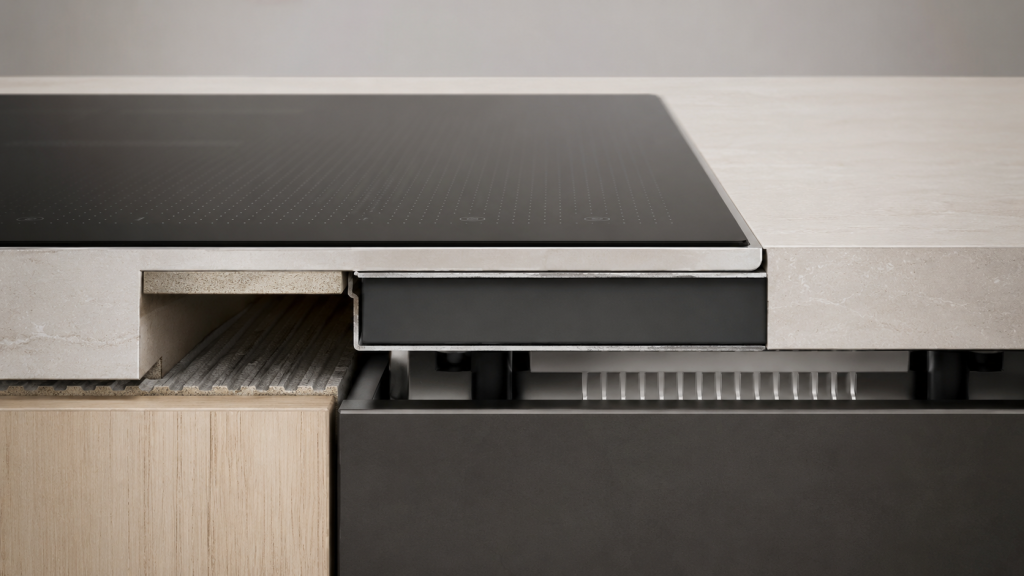
In a conventional installation, The glass of the plate rests on the countertop and its perimeter is a few millimeters above. In a flush installation, a recess or perimeter milling to accommodate the edge of the plate and ensure that the glass and countertop are practically on the same plane.
That detail changes the manufacturing quite a bit.. It is no longer enough to open a hole for the body of the appliance: The support zone must also be executed with the dimensions and depths indicated by the plate manufacturer. The correct reference is always the assembly drawing of the specific model, not a standard measure taken from another apparently similar induction.
Advantages of an induction hob flush with the countertop
The most obvious reason to choose this system is aesthetics.. The transition between countertop and plate is much more discreet and allows you to create a visually continuous surface, something that is especially appreciated on islands, peninsulas and kitchens open to the living room.
It also changes the user experience. When the raised edge around the glass disappears, it is easier to remove crumbs or small debris from the surface. However, It is worth qualifying a common idea: flush does not mean total absence of joint. The necessary separation between plate and countertop must be respected to absorb tolerances, protect the materials and allow the assembly intended by the manufacturer.
- Greater visual continuity: the plate integrates better with the work plane.
- Minimalist finish: reduces the visual presence of the appliance.
- More direct surface cleaning: there is no elevated frame around which debris accumulates.
- Especially attractive on islands: the cooking area is more integrated into the overall design.
- More customization possibilities: allows you to work on the meeting between stone and appliance as part of the countertop design.
The counterpart is that requires more manufacturing precision than a countertop mount. If the gap is too big, little, deep or irregular, the defect will be visible around the entire plate. That is why the final finish depends on both the appliance and the previous work on the surface..
Requirements to correctly install a flush induction
The decision should be made before manufacturing the countertop. At Marbres Barcelona we work custom kitchen countertops based on the real characteristics of each project, so that the chosen plate must be part of the planning along with the sink, taps and other elements that require machining.
In this type of work, a few millimeters have visible consequences. That is why we use measurement systems such as Proliner and manufacture the parts in the workshop before installation.. Correctly measuring space is only part of the process: We also need the definitive technical documentation of the induction.
The plate must accept flush installation
Not all induction hobs are designed to be mounted this way.. Some only allow countertop placement, while others support both systems. The manufacturer's sheet must expressly indicate the possibility of flush installation.
It is advisable to decide on the model before ordering the machining. Even between plates 60, 80 o 90 cm, body measurements, glass and recess may vary. Buying the countertop first and then choosing a hob that “seems to fit” introduces unnecessary risk.
The hole and the recess must follow the technical plan
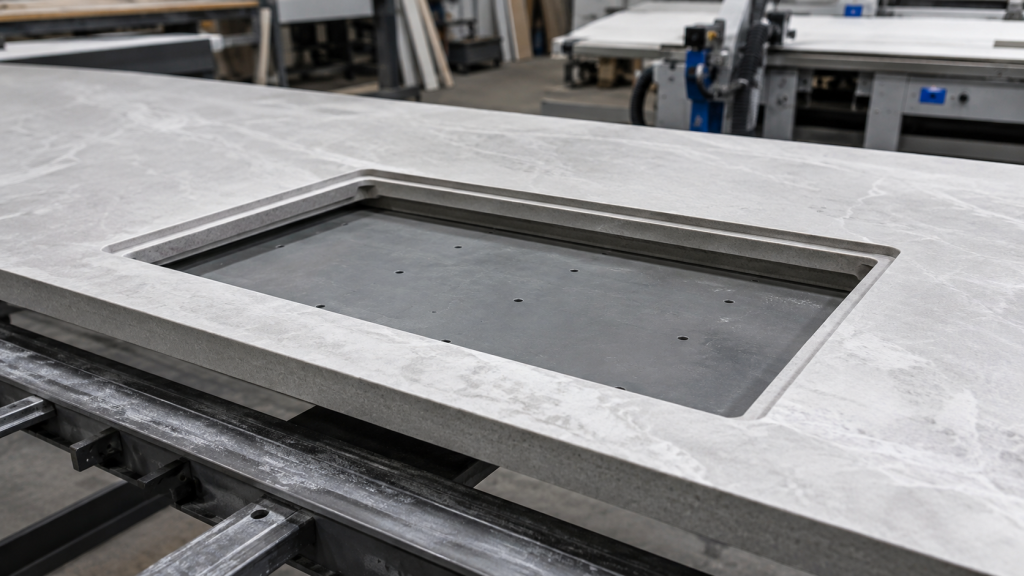
A flush plate usually requires two related geometries: the interior space that receives the body of the device and an upper recess that houses the edge or glass. Depth, Corner radii and side dimensions depend on the model.
The machining must be clean because its perimeter remains next to a visible surface. Besides, the thickness of material remaining after milling must remain adequate. It is not advisable to improvise a recess on an already finished countertop without previously studying the material, thickness and distances available.
You must leave the joint provided by the manufacturer
The goal is not to press the glass against the stone.. must exist a perimeter joint sized according to the assembly instructions and resolved with the sealing system specified for the appliance and countertop material.
Measurements are not universal. Some manufacturers establish minimum separations and specific types of sealant for their models.. It may also be necessary to use products compatible with natural stone.. Copying the gasket used in another kitchen does not guarantee correct assembly.
Bottom ventilation is still essential
That the surface is perfectly integrated does not eliminate the technical needs of the appliance. The electronics of an induction hob generate heat and need the tickets, outlets and ventilation distances indicated by its manufacturer.
This affects the design of the lower cabinet, especially if there is a drawer or other appliance underneath. On plates with integrated extractor, Planning is even more important because it is also necessary to resolve conduits, filters or recirculation. The exterior appearance can be minimalist, but the technical space under the countertop must continue to function properly.
The board must be removable in the future
A good installation also thinks about maintenance. Induction is an appliance and may require service, repair or replacement over the years. Thus, should not become irreversibly trapped inside the countertop.
The lower access, The sealing system and the arrangement of the furniture must allow intervention on it without having to damage the surface.. This point is especially important when looking for extreme integration and trying to hide any visible joints..
What countertop materials are best for a flush plate
There is no single valid material for all plates and all projects.. Final compatibility depends on the appliance manufacturer, from the surface manufacturer, of the selected thickness and installation detail. Even so, There are materials especially suitable for precise machining work.
At Marbres Barcelona we work with different natural stones, quartz and porcelain surfaces. To decide, it is advisable to evaluate both the resistance of the surface and the behavior of the machined edges., why recessing a flush plate leaves an area that is more demanding than a simple flat surface.
Porcelain and sintered stone: a very complete option
Porcelain and sintered surfaces fit especially well in kitchens with contemporary design due to their low porosity., resistance to daily use and variety of finishes. In our projects custom porcelain countertops we can study the machining necessary to integrate the cooking zone from the manufacturing phase.
Brands like Dekton, Neolith, Lapitec, Laminam, Inalco, Techlam, Xtone or Sapienstone offer multiple solutions for countertops, although Each product has its own manufacturing instructions. It should not be assumed that all thicknesses, collections or configurations support exactly the same milling.
When the project is proposed with this surface, we can also work with custom Dekton countertops. The thickness decision, hole and perimeter detail must be taken together with the plate model to be installed.
Granite: very suitable when working correctly
Granite is another interesting alternative for this type of integration.. As it is a resistant natural stone and suitable for professional machining, allows you to execute precise recesses to accommodate the plate as long as the design preserves enough material in sensitive areas.
Keep in mind that each table is different.. Vetoed, mineral structure, thickness and position of the hole can condition the work. A plate located too close to an edge, a joint or a second gap can create a more structurally delicate area, hence the complete geometry of the countertop must be studied before cutting.
Compact quartz: possible, but you have to check the conditions
Quartz surfaces are common in kitchens and allow for a great variety of aesthetics.. A flush installation may be feasible, but it must be verified that the selected product and thickness support the intended machining and respect the technical instructions of the brand.
Containing resins, Its behavior at high temperatures is different from that of a natural stone or certain sintered surfaces.. This does not mean that an induction hob is incompatible., but yes It is not advisable to automatically transfer construction details from one material to another..
Marble: technically possible in some projects, but less practical
Marble can be machined with enormous precision and certain slab manufacturers consider flush installations on natural stone.. However, For a cooking zone with intense use it has other peculiarities: is more sensitive to acids, stains and certain household products What materials specifically designed for a battle kitchen?.
For that reason, if the priority is to combine flush induction, simple maintenance and intensive use, porcelain tiles are usually easier to recommend, sintered surfaces or certain granites. To assess the differences in more detail, in our comparison between marble, granite, quartz and porcelain We analyze how each family of materials behaves in a kitchen countertop.
Errors that can ruin a good flush finish
Most problems don't arise because the idea of flushing is complicated., but because decisions are made in the wrong order. Choosing the hob after manufacturing the countertop is one of the most common examples: forces you to look for an appliance that fits the existing space instead of manufacturing the space for the appropriate appliance.
Another mistake is to only assess how it will look from above.. Ventilation still exists beneath the surface, cabling, plate body, drawers and possible extraction systems. Correct aesthetic integration also requires correct technical planning.
- Order machining without having the final induction model.
- Use the outside dimensions of the glass instead of the installation drawing.
- Reduce the perimeter joint, making it visually disappear.
- Failure to check the compatibility of the material and its thickness with milling.
- Forget the needs of ventilation under the plate.
- Placing the hole too close to the edges, unions or other machining.
- Sealing the board without foreseeing how it will be dismantled for maintenance.
The safest way to avoid these problems is coordinate countertop, plate and furniture before starting manufacturing. Flush finish works especially well when it is conceived from the beginning as part of the project and not as a modification added at the end.
Can a plate be flushed on an already installed countertop??
In some cases yes, but it shouldn't be taken for granted. You have to check the existing plate, the size of the hole, The material, its thickness, the position of the furniture and if it exists Sufficient margin to make the recess without weakening the countertop.
Besides, Working on an installed surface is different from machining a part in the workshop. If you are renovating the entire kitchen or replacing the countertop, it is usually preferable plan the screed before manufacturing the new part. If only the appliance is changed, It is advisable to first study the real feasibility.
Frequently asked questions about flush induction hobs
Can any induction hob be installed flush??
No. The manufacturer must expressly contemplate this type of assembly. Some plates allow countertop and flush installation, while others are designed for a single configuration.
Is a flush plate completely attached to the countertop??
A rigid contact between both elements should not be sought.. The joint indicated in the assembly instructions must be respected, in addition to the appropriate sealing system for the plate and the surface.
Is a flush plate better than a conventional one??
Depends on the priority of the project. Flushing provides continuity and a particularly refined finish; countertop installation is usually easier. The main difference is in the design and the requirement of assembly, not on plate cooking technology.
Can porcelain tile be milled to install a flush induction?
Can be worked to perform precision machining, but the specifications of the concrete surface must be respected, its thickness and the plate manufacturer's instructions. Not all products must be machined exactly the same way.
What must be delivered to the marble worker before manufacturing the countertop??
The ideal is to facilitate the exact reference of the board and its installation documentation. If there are other integrated elements, as sink, extractor or faucet, They must also be defined to coordinate all gaps and distances.
Precision is decided before manufacturing the countertop
A flush induction hob can achieve one of the cleanest finishes in a kitchen, but the good result depends on decisions that are barely seen when the work is finished. Board template, material, thickness, milling, gasket and ventilation must be resolved as a whole.
At Marbres Barcelona we measure, we manufacture and install custom countertops and we can study these details before machining the surface. If you want to incorporate a flush induction, The most useful thing is to first define the appliance and the material: so we can adapt manufacturing to the real project and avoid improvised solutions during assembly.
