Combining wood and natural stone allows you to create a contemporary kitchen with warmth, texture and an aesthetic that does not depend on fads. The result, however, does not improve by adding more materials, but to decide which will have the leading role, coordinate tones and veins and take care of how light comes into play, soil, the metal profiles and the rest of the architectural elements.
A well-designed kitchen can rely on light wood and a discreet stone., look for an intense contrast between walnut and light mineral surfaces or turn a stone island into the visual center of the room. The right combination depends on the space and the feeling we want to achieve., not from a universal formula.
Why wood and natural stone work so well together
Wood introduces a visually warm surface, with variations in grain and tone that soften the usual straight lines in a contemporary kitchen. The stone provides a more mineral and architectural presence. The interest appears precisely in the contrast between both textures.: one is warmer and more organic; the other transmits solidity and continuity.
They also share an important characteristic from an aesthetic point of view: each piece has its own nuances. This prevents the kitchen from appearing excessively flat., even when furniture has smooth fronts, The handles are integrated and the distribution is minimalist. The materials themselves can provide depth without needing to overload the decoration.
In a contemporary kitchen it is advisable to take advantage of that character without trying to make wood and stone compete.. If the stone has a very marked vein, A relatively calm wood usually works best.. If the wood has a lot of knots or contrast, a more uniform stone can act as a background. The more expressive a material is, more content should be the other.
Start by defining what material will take center stage.
Before comparing wood species or stone types, It is convenient to decide where we want to direct our gaze. An island clad in natural stone can become the centerpiece of the project; instead, an entire wall of wood columns can provide most of the personality while the stone is limited to the countertop. Establishing a hierarchy avoids the material catalog effect.
It is not necessary to distribute both surfaces equally. In fact, uneven distribution usually produces more natural compositions. We can use one of the materials as a base and reserve the second for the areas where it really provides contrast., visual protection or continuity. Balance does not mean using a 50 % of each material.
Light wood with beige or cream stone
light oaks, ash and low-saturated wood finishes combine especially well with sand-toned stones, crema o greige. It is an appropriate solution when we look for a bright kitchen, serene and visually light, especially in spaces open to the living room.
So that the result is not too uniform, we can introduce small elements in black, graphite or dark aluminum in luminaires, profiling, taps or carpentry. A specific contrast helps to draw the architecture without breaking the feeling of calm.
Medium or dark wood with light stone
Walnut and other medium or dark wood tones provide greater depth. Combined with a light stone they allow volumes to be marked quite clearly.: dark columns in the background, For example, and a brighter mineral island in the foreground. Contrast works especially well when there are large surfaces and few interruptions.
This combination can also be used in small kitchens., but it is advisable to dose the dark tones and observe the actual entry of light. An attractive display under display lighting can change considerably within a home. The materials must be evaluated together and in the light of the final space.
Dark wood and stone
A tonal upon tonal combination can lead to very enveloping kitchens.. smoked woods, rather, Deep gray stone or almost black surfaces work when there is enough space and well-planned lighting.. In these proposals, texture replaces color contrast.
So that the set is not heavy, It is preferable to avoid all elements having exactly the same darkness. Variations in the soil, the walls, the ceiling or window openings allow each volume to retain its reading. A dark kitchen needs nuances, not necessarily light colors.
Where to use wood and where to place stone
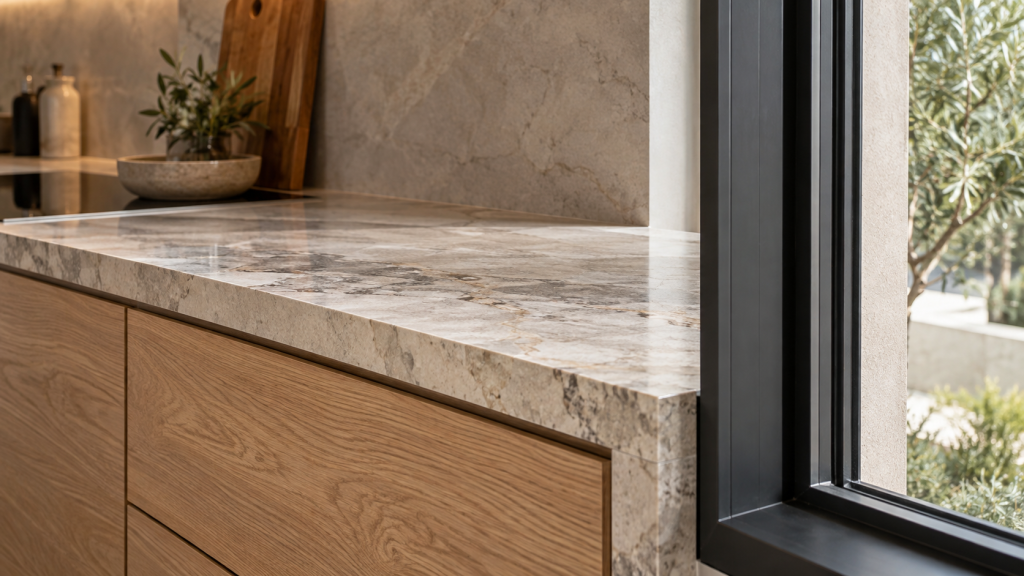
The position of each material influences as much as its color. Stone finds a natural place on surfaces subjected to intense use and, visually, works great on countertops, island fronts and volumes. Wood can occupy closet doors, columns, pans the auxiliary furniture. Assigning each material a clear function improves design consistency.
It is also worth thinking about the lines of continuity. A countertop that rises along the kitchen front can generate a clean mineral plane; a wall of wood-clad columns can hide storage and appliances within a single volume. Continuous surfaces usually convey a more contemporary aesthetic than a succession of small decorative pieces.
- Worktop: allows the stone to have a presence without dominating the entire room.
- kitchen front: continuing the stone from the countertop reduces material changes and provides continuity.
- Isla: It is a good place to turn a stone with personality into a protagonist.
- Fronts and columns: wood helps soften large storage surfaces.
- Shelves or niches: allow the wood to be repeated in small doses when the main material is stone.
You have to consider, besides, the soil as part of the composition. Although he is not the protagonist, occupies a very large visual surface. A floor with too much grain can compete with an already expressive countertop and wood, so it is usually interesting to keep at least one of the three planes in a calmer register.
What natural stone to choose for a contemporary kitchen
Not all stones look the same or require the same care.. Granites, cuarcitas, marbles, limestone or travertine can give very different results. Beyond the commercial name, interested in valuing porosity, finish, drawing, maintenance and intended use before deciding only on a photograph.
Stones with pronounced patterns function as a graphic element. on a big island, a marked grain can make a lot of sense; in a kitchen with numerous modules, joints and plane changes, It may be easier to work with a visually homogeneous stone. The size of the surface should influence the intensity of the stone chosen.
Granite and quartzite for a sharp mineral look
Depending on the variety chosen, Granite and quartzite allow you to work from relatively uniform tones to much more expressive drawings.. They can be interesting when we search a clearly stony presence and a surface with its own personality.
With a dark or highly veined stone, A content drawing wood helps maintain balance. A clear and discreet stone, instead, accepts woods with greater contrast between fibers and tones.
Marble for a more prominent vein
Marble can turn a countertop or island into the focus of the kitchen, especially when there is continuity between the horizontal surface and the sides or vertical cladding. Its grain must be treated as part of the composition, not as a standalone print.
It also requires assuming the particularities of a natural stone of this type.. Before choosing it, it is advisable to find out about the finish, the sealing and care recommended for the specific variety. The aesthetic choice must be compatible with the maintenance that we are willing to carry out..
Travertine and limestone for a warm palette
sand tones, beige and cream allow you to build kitchens with a Mediterranean or minimalist aesthetic without resorting to pure white. Combined with oak, Walnut or other warm woods can produce a very integrated environment with smooth transitions.
In these cases it is especially important to compare the samples with the flooring and the paint on the walls.. When all materials move in a similar range, small differences between a yellowish beige, pink or grayish are perceived more clearly.
Aluminum can complete the combination without subtracting warmth
A contemporary kitchen is not only made up of furniture and countertops. Windows, doors, profiles and other elements can intervene directly in the reading of the space. Aluminum allows for the introduction of precise lines and neutral finishes that interact well with wood and stone., especially when we repeat the same metallic tone in several points.
At Araque Aluminios we manufacture custom solutions and we can adapt finishes and configurations to the needs of each room.. When the renovation affects access to the kitchen, our aluminum doors for kitchen They allow us to propose solutions from glass to different opening systems.. The carpentry can be part of the design instead of being an isolated element.
Windows that accompany the material palette
If the kitchen has an exterior window, Its finish can be used to reinforce the whole. A dark profile creates a graphic frame around views, while a tone closer to the wall reduces its presence. In our range of aluminum windows we work different configurations and finishes, including imitation wood finishes. It is not mandatory to introduce a third color to incorporate aluminum.
The choice of the opening system must also respond to the daily use of the kitchen.. Countertops, emphasis, tall furniture and passageways can affect the movement of a leaf. Design and functionality must be resolved at the same time, especially in compact spaces.
Aluminum ceilings in kitchen renovations
In certain renovations, a metal false ceiling may also make sense.. In Araque we install aluminum ceilings for kitchens, a solution that can be integrated into projects where a practical and easy-to-clean surface is sought. The ceiling should be coordinated with the rest of the space and not chosen independently.
When wood and stone already have a lot of presence, It is usually easier to keep metal elements in a limited range. Repeat profile finishing, handles or luminaires generates a visual relationship between pieces that might otherwise appear disconnected.
Light completely changes the perception of wood and stone
The same wood can look more golden, gray or reddish depending on the orientation of the home and artificial lighting. The stone also changes: polished surfaces reflect the environment more, while matte finishes usually show the drawing in a different way. Choosing materials without checking them together under real light adds unnecessary risk.
Before closing the combination, it is advisable to place vertical and horizontal samples in the kitchen and observe them at different times.. It is not enough to rest all the pieces on a table: a sample intended for the front should be seen vertically and a countertop, horizontally. The incidence of light is part of the final finish.
Artificial lighting can also be used to highlight textures. A well-placed light on a stone wall reveals reliefs and variations; uniform lighting on wood helps to appreciate the continuity of the grain. The goal shouldn't be to illuminate every surface dramatically, sino ensure that the material retains its natural appearance during everyday use.
Errors that can break the balance of the kitchen
The majority of failed combinations are not due to wood and stone being incompatible., but because separate decisions have been made. First choose a countertop, then a floor and months later the furniture can generate small differences in tone and texture that, together, produce visual noise. The kitchen must be evaluated as a whole from the beginning.
Another common mistake is turning every surface into a point of attention.. If we have wood with a lot of knots, intensely veined stone, pavement with very contrasting patterns and profiles, no piece really stands out. Leaving surfaces visually silent makes the main materials work better.
- Combining several woods with clearly different color temperatures without a defined intention.
- Choose a stone solely from a photograph and not from a real sample.
- Introduce too many veins and drawings on the floor, furniture and countertop.
- Decide profiles, handles and taps at the end without checking how they communicate with each other.
- Ignoring the orientation of the kitchen and the amount of natural light available.
- Prioritize the aesthetic trend over the maintenance required by each surface.
An easy way to detect these problems is to collect all the samples before placing the final order.. Madera, piedra, floor, paint and metallic finishes should be able to be seen together. If one element seems to immediately compete with all the others, probably needs to lose prominence.
Three approaches to get it right depending on the type of cuisine
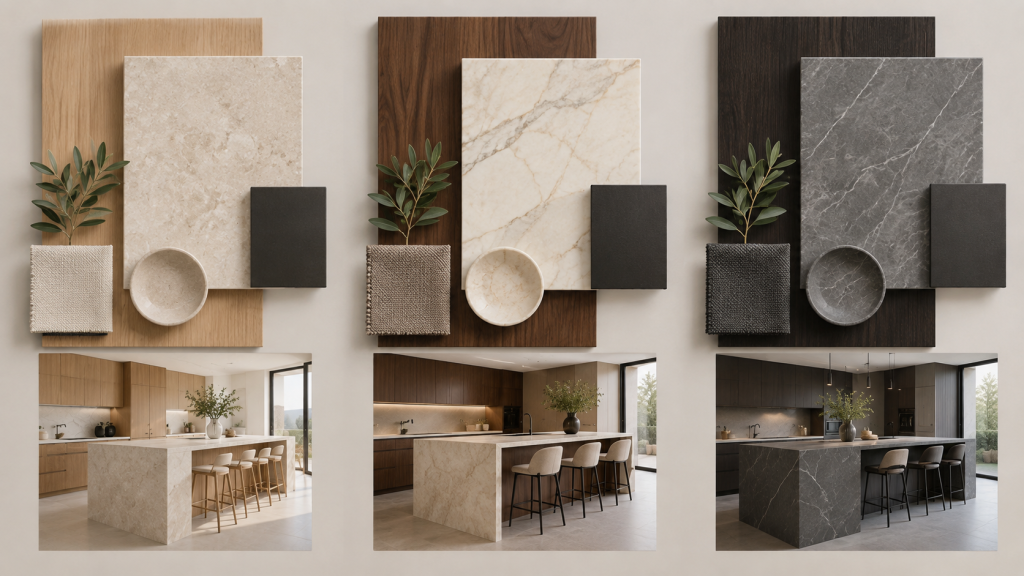
In a small kitchen a contained composition usually works: light or medium wood on certain fronts, relatively uniform stone and few finish changes. Doesn't mean giving up character, but concentrate it. A single main surface can give more depth than five different materials.
In large spaces or kitchens open to the living room, there is more room for contrasts and differentiated volumes.. The island can function as a stand-alone mineral piece while the wooden columns establish a more domestic transition to the dining room.. The scale of space allows each material to have enough distance to breathe.
For a bright and serene kitchen
We can combine light oak, cream or beige stone, off-white walls and small dark metallic details. The result maintains a warm range but prevents everything from having exactly the same tone.. Soft variation creates depth without losing luminosity.
For a kitchen with greater contrast
A medium or dark wood together with light stone creates a clear separation between furniture and work surfaces. The black profiles, graphite or anthracite can prolong this contrast if they appear in a dosed manner. Repeating a few finishes produces more coherence than introducing many different tones.
For a contemporary Mediterranean-inspired kitchen
warm woods, Beige stones and matte surfaces allow you to reinterpret the Mediterranean aesthetic with cleaner lines. The interest may be in the natural irregularities of the materials and not in adding ornaments. Texture can add character while maintaining simple architecture.
Frequently asked questions when combining wood and natural stone
Before choosing finishes, doubts about color appear, maintenance and proportions. There is no identical answer for all projects, because the light, dimensions and daily use modify the decision. The best combinations are those that work within real space, not only in an inspiration image.
These answers serve as a starting point to narrow down options before comparing samples and defining the rest of the kitchen elements..
Should wood be lighter than stone?
No. Light wood can work with dark stone, dark wood with light stone or a tonal composition with both surfaces in similar registers. The important thing is to control the overall contrast and decide which of the two materials we want to highlight.
Can several woods be mixed in the same kitchen??
Yeah, although it is advisable to do it with intention. If there is already a wooden floor, For example, the furniture does not have to reproduce it exactly, but there should be some relationship between color temperatures or intensity. Trying to imitate a wood without success can be less coherent than deliberately choosing another.
What color aluminum combines best with wood and stone?
Depends on the palette. Blacks and anthracites generate contrast; light tones can be integrated with luminous walls and stones; Wood effect finishes make it possible to reduce the visual presence of metal in certain projects. The most appropriate finish is the one that maintains the chromatic logic of the entire kitchen..
Is it better to use the same stone on the countertop and front??
It can be a good solution when we are looking for continuity and want to reduce the number of visible materials. It is not essential: We can also combine a stone countertop with a neutral wall if the stone has a lot of personality. Repeating a material must provide order, not become an automatic rule.
A combination designed as part of the entire architecture
Wood and natural stone work especially well when we stop treating them as two independent finishes and relate them to the floor., the light, proportions and carpentry. A compelling contemporary kitchen is built through relationships between materials, not accumulating trends.
Before deciding, it is worth comparing the samples within the room, Establish which surface will be the protagonist and define from the beginning the elements that will complete the space. If the project includes new doors, windows or other aluminum solutions, At Araque Aluminios we can study custom carpentry to integrate it into the functional and aesthetic needs of the kitchen.. Resolving these elements as part of the project helps achieve a more coherent result.
