When a countertop gets scratched, chips or loses shine, the doubt is logical: Is it fixed or changed?? The answer depends on the material, the type of damage and whether you are looking for a “like new” result or simply improving the appearance. With a correct diagnosis, Many incidents have a solution without undergoing a complete reform.
First: Yeah, many countertops can be repaired (but not all the same)
There are damages that are superficial and others that affect the structure. To decide wisely, it is convenient to separate what is finish (glow, touch, microscratches) of what it is integrity (cracks, breaks, movements, support swelling).
At Marbres Barcelona we see it often: a countertop can “look” very damaged by light and use, but be recoverable with polishing or localized repair. And vice versa: A crack that appears small may indicate an underlying problem that it's not worth patching.
Most common types of damage and what can usually be fixed
Scratches and microscratches
Stripes can range from superficial marks to actual grooves. The important thing is to know if the damage is in the “skin” of the material or if it has penetrated. In general, In polishable materials, recovery is based on equalize the surface (polished or polished), while in very hard materials you work with specific techniques.
- thin stripes (veil type): They usually improve a lot with proper cleaning and, we proceed, pulido.
- deep stripes: may require localized repair and finishing review so that it does not “sing”.
With our clients, the key point is expectation: if you want it to be perfect, The repair must be considered as a maintenance job. integral finish, not just “cover it”.
Chips and bumps (edges and corners)
The edges are the most punished area: bags, pans, tray angles… A chip is usually repairable, but the result depends on the texture, the color and whether there is a marked grain. Here the difference between a fix and a good job is in rebuild volume and color with judgment.
- small blow: It usually repairs and integrates quite well.
- Corner hit: requires more hand, because the geometry is noticeable.
- Break with fissure: It is necessary to assess if there is tension or movement of the support.
At Marbres Barcelona we usually review songs, supports and leveling, because if the hob works (flexes or moves), the chipping returns. The good repair is the one that does not repeat.
Loss of shine and matte areas
Loss of shine can come from microabrasion (aggressive cleaning), by lime, due to inappropriate products or simply due to use. On many surfaces it is recovered with a finishing review, but it is important that the solution is consistent with the material: not everything is treated with the same system, nor does it make sense to “force” a high gloss if the countertop is used a lot.
In our case, When someone asks to “shine again”, first we define the objective: uniformity (that there are no patches) and a realistic finish for everyday use.
Repair countertop according to material: what to expect in each case
Repair Silestone countertop (compact quartz)
Silestone and other compact quartz usually allow for repairs of chips and dents with good results if the color matches.. Fine stripes are sometimes hidden, but it is not always interesting to “sand” without control, because you can change the appearance of the area. The most important thing is to avoid aggressive home methods: a bad attempt can leave a halo mate more visible than the original stripe.
With our clients, What works best is to assess whether the damage is in a visible area and whether it deserves a localized repair or a broader intervention so that the finish is homogeneous.
Repair Dekton countertops and other porcelain tiles
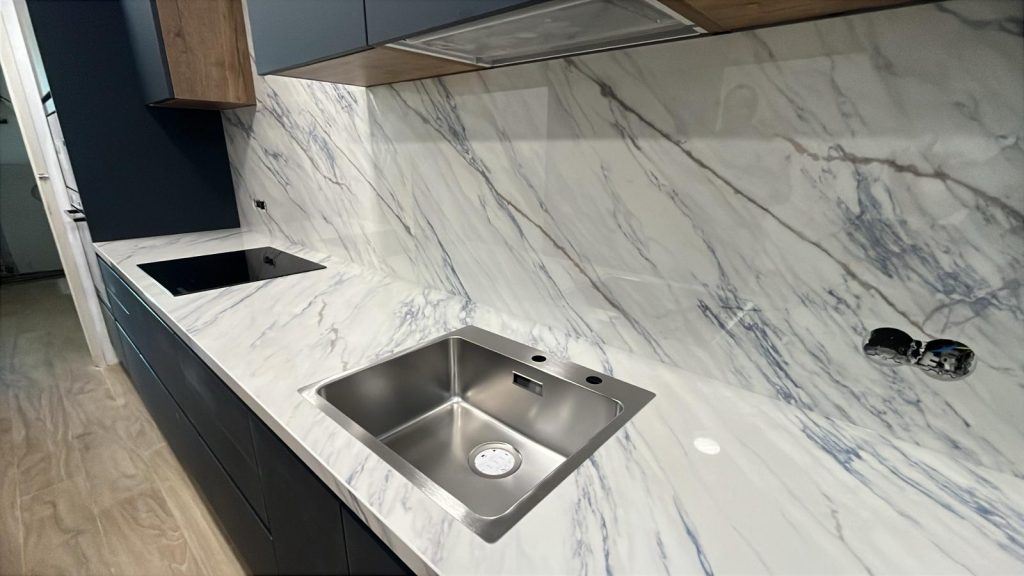
Dekton and porcelain surfaces are very resistant, But when they are damaged, they usually do so on edges or from specific impacts.. The repair exists, but it's more technical: It's not about “polish and that's it”, but to reconstruct and conceal with precision. In Marbles Barcelona, when the material is porcelain, We prefer to propose the solution with a mentality of restoration: that is integrated and stable.
If you are comparing options or already have porcelain installed, you can see features and finishes in Porcelain, because the type of surface and the finish greatly change the visibility of marks and repairs.
Repair granite countertop
Granite is grateful on a daily basis and usually ages well. Small dents can be repaired and, depending on color and grain, They are very discreet. Deep streaks are less common, but if they appear, They are valued according to the area and type of finish. The goal is usually one: that is not noticeable to the touch and that visually does not stand out.
Repair natural stone (marble, quartzite, etc.)
In natural stone there are two realities: the beauty of the grain and the sensitivity to use (depending on stone type and finish). The marble, For example, can be marked further with acids or abrasives, but it also usually allows very good recoveries if the finish is worked well.. Here the decision is not just “repair or not”, but what finish should you maintain so that use is comfortable?.
If your countertop is made of stone or you are thinking about a new one, in piedra natural you will see options that completely change the experience: some stones are more delicate and others are true “all-terrains”.
Can I repair it myself or is a professional better??
For maintenance and small improvements, there are safe actions: correct cleaning, avoid aggressive scouring pads and act quickly on stains. But when we talk about visible stripes, chipping or uneven gloss loss, The usual thing is that a homemade attempt leaves a lot or worsen the finish.
At Marbres Barcelona we usually recommend a simple criterion: If the damage is visible from the kitchen entrance, if it is on the edge or if it affects a water/heat area, a professional solution is advisable. The goal is not to “cover up.”, es integrate so that it is not noticeable and lasts.
When it pays to repair and when it is better to change
The correct decision is usually the one that minimizes “double spending”. Repair pays when the problem is localized and the countertop is properly installed. Changing compensates when the damage is repeated or there are underlying causes (motion, deteriorated support, humidity). To help you decide, here is a quick table:
| Problem | Does it usually pay to repair? | When is it recommended to change |
|---|---|---|
| thin stripes and micro scratches | Many times yes, if you are looking to improve uniformity | If the material does not allow recovery or there is general wear |
| small chip in song | Yeah, if color and shape can be integrated | If there are multiple hits or very damaged edges |
| Loss of shine by zones | Yeah, with well-planned finishing review | If the support is bad, there is deformation or joints fail |
| long crack or structural breakage | It depends: cause and tension must be diagnosed | If there is movement, lack of support or risk of reopening |
| Swelling due to humidity (typical on sensitive media) | Normally not | When support is degraded and will continue to get worse |
In practice, the key question is this: Is the countertop “healthy” and is the problem aesthetic?, Or is there a reason it will keep breaking?? At Marbres Barcelona we prioritize an honest recommendation: if the repair is going to last, it's worth it; if it is bread for today, better rethink.
Clear signs that it should be replaced
There are situations where, for security or accumulated cost, change is the sensible thing to do. The most common signs are usually:
- Structural damage affecting stability or support.
- Multiple breaks or repeated cracks in different areas.
- Basic problems: unevenness, lack of reinforcement, unsupported gaps.
- Persistent humidity which has degraded support.
If any of these points sound familiar to you, the useful thing is to evaluate the whole: worktop, furniture, supports and joints. Many times the “impossible repair” is not impossible because of the material., but for how is it installed.
Quick checklist to decide on 5 minutes
If you want a practical decision before requesting quotes, use this filter:
- Damage location: Is it on a visible edge or in a less exposed work area??
- Size and repetition: Is it a specific blow or a sum of many?
- Material and finish: Is your countertop porcelain, quartz, granite or natural stone?
- probable cause: Was it an isolated impact or are there signs of movement/moisture?
- Real goal: Do you want to “improve a lot” or “make it impeccable?”?
With that information, the recommendation usually comes out alone. In Marbles Barcelona, when they bring us photos or show us in person, the value is in landing it in your case: what repair makes sense and what result to expect without unrealistic promises.
A well-chosen and well-installed countertop is built to last.. If the problem is cosmetic or localized, repair can be a smart solution. And if the damage points to something deeper, The best investment is to decide in time: avoid repeating arrangements and opt for a surface that fits with your way of living in the kitchen.
