Choose material for your countertop: much more than an aesthetic decision
The choice between marble, granite, quartz and porcelain makes a difference in how you will live your kitchen: daily maintenance, endurance, quality feel and long-term durability. Understanding the characteristics of each material well will help you invest wisely and create a kitchen that will continue to be beautiful and functional for many years to come..
In Barcelona marbles we have more than 35 years installing countertops in kitchens in Barcelona, Sabadell and surroundings, and we see every day that the best choice is not “the fashionable material”, but the one that fits with you lifestyle, budget and usage expectations.
Before comparing materials: what you should be clear about your kitchen
Before deciding if it is better marble, granite, quartz or porcelain, It is worth answering some practical questions. This allows you to rule out options that, even if you like them visually, they might not work well in your daily life.
In our case, in Marbres Barcelona we usually start by asking: how much do you cook, If the kitchen is a social space, If there are children at home and how much time you want to dedicate to maintenance. With these answers, the choice becomes much easier.
- Actual kitchen use: do you cook daily, only weekends or almost nothing?
- Household profile: families with children, couples receiving visitors, tourist rental, etc.
- Maintenance tolerance level: do you mind sealing, dry and care, or do you prefer to clean and go?
- Aesthetics and style: Are you looking for a very natural kitchen, more minimalist or luxury inspired?
- Project budget and duration: Reform for “lifelong” or medium-term solution?
With these clear variables, you can now analyze the differences between marble, granite, quartz and porcelain with a much more specific look, thinking about your kitchen and not about a generic kitchen from a catalog.
Marble, granite, quartz and porcelain: What are they and how are they different?
Although at first glance they may all look like “stone”, The reality is that each material has an origin, very different behavior and care needs. Understand this technical basis, explained in clear language, is key to get the countertop right.
At Marbres Barcelona we work daily with natural stone and technical surfaces, so we summarize the essentials of each material applied to kitchen countertops.
Marble: classic elegance and character, but more delicate
He marble It is a natural metamorphic stone, Known for its grain and for that feeling of timeless luxury it brings to any countertop.. Each piece is unique, no two tables are the same, making it a highly appreciated option in high-end projects.
However, The marble is more porous and sensitive to acids (vino, lemon, vinegar, sauces…) than other materials. This means that it can stain or mark more easily and requires more careful maintenance., with periodic sealing and some attention on a daily basis.
- The best of marble: unique natural beauty, soft touch, luxury look and lots of personality.
- Disadvantages: more prone to stains, scratches and acid marks; It is not the most recommended for “battle” kitchens..
In projects where the client seeks a very scenic kitchen and is willing to take care of her, At Marbres Barcelona we continue to use marble, especially on islands, bars and spaces with more careful use.
Granite: resistant and very functional natural stone
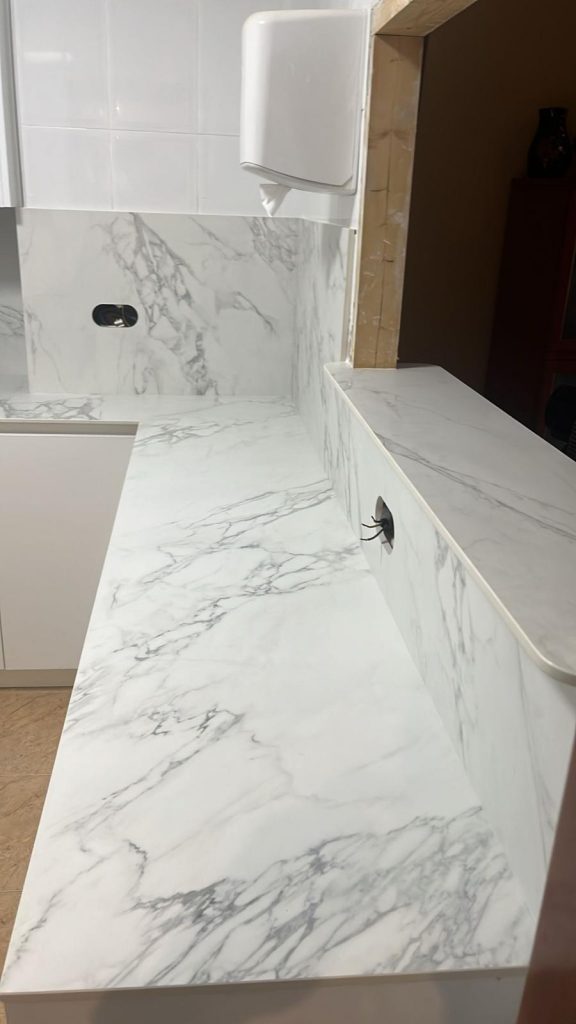
He granite It is also a natural stone, but harder and more resistant than marble. Withstands heat very well, shocks and intensive use, so it remains a classic in family kitchens that want a natural material with good durability.
Although it is harder, granite remains slightly porous, so it is also advisable to seal it to minimize the absorption of liquids and facilitate cleaning. The range of colors is more limited than in quartz or porcelain, but its veins and grains give it a very authentic appearance.
- The best of granite: high resistance to heat and shock, solid and natural stone feel.
- Disadvantages: requires periodic sealing, somewhat less variety of colors and finishes than in synthetic materials.
With our clients, we recommend granite when they want stone 100 % natural and a very reasonable balance between aesthetics, resistance and price, specially in family kitchens in Barcelona and Sabadell.
Compact quartz: uniform aesthetics and very little maintenance
The countertops of compact quartz (like Silestone and other similar brands) They are materials made from crushed natural quartz, resins and pigments. The result is a very hard surface, non-porous and easy to clean, with a wide variety of colors and finishes.
His main strength is day to day: does not need sealing, It does not absorb liquids and is very resistant to stains and bacteria. That makes it one of the favorite options for those who want a designer kitchen that is beautiful and very practical to maintain.
- The best of quartz: wide color chart, great resistance to stains and scratches, hygiene and low maintenance.
- Disadvantages: It is not advisable to directly support pots that have just come off the heat.; better to use trivets.
In Barcelona marbles Quartz is one of the most popular options for individuals who renovate their home., because it offers a very interesting balance between modern aesthetics, ease of use and price. If you are interested in going deeper, You can see examples and options in our quartz kitchen surfaces.
Porcelain: ultra-compact and highly technical surface
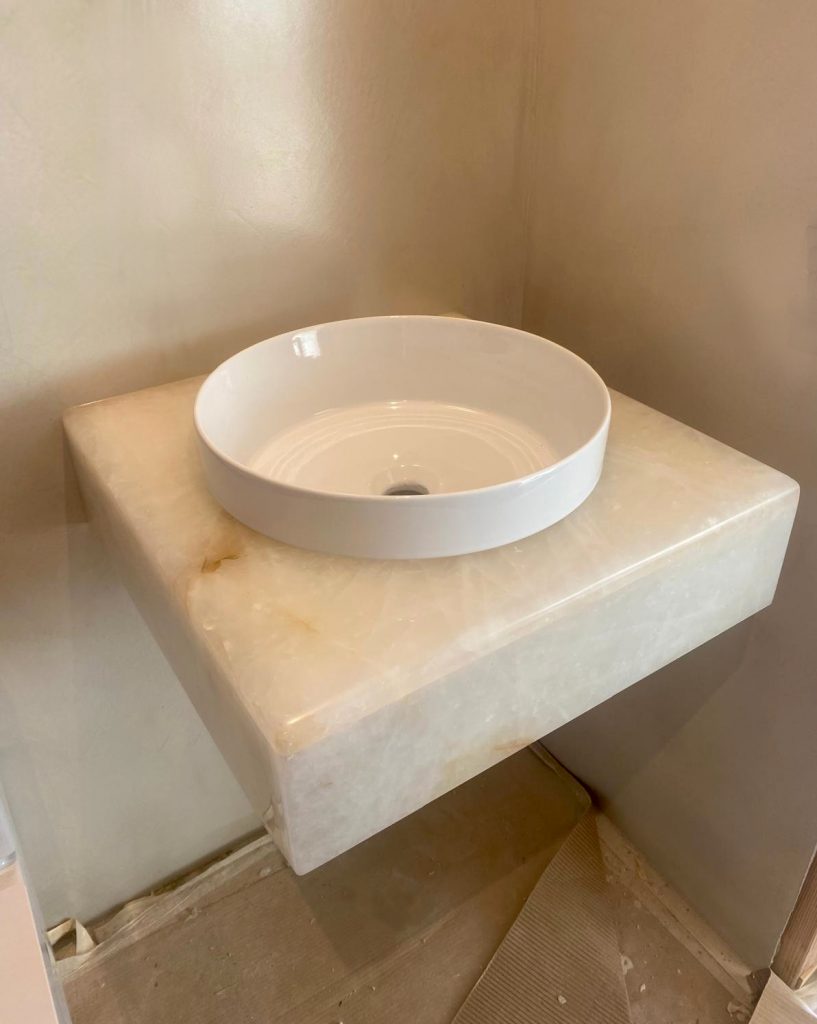
He porcelain for countertops is an ultra-compact ceramic material, produced with natural minerals subjected to high pressures and temperatures. This gives you a very low porosity and great resistance to stains, scratches, heat and even UV rays, so it is also used in outdoor kitchens.
Another important advantage is its ability to imitate other materials: can reproduce the look of marble, of cement or natural stone, but with a much more stable behavior against intensive use.
- The best of porcelain: very high resistance, very low porosity, suitable for outdoors and huge variety of designs.
- Disadvantages: It is more technical to work, and the edges can be somewhat more delicate when faced with very strong blows.
With our clients who are looking very modern designer kitchens, At Marbres Barcelona we usually propose custom porcelain tiles, especially when they want visual continuity between countertops, front and sides.
Quick summary: marble comparative table, granite, quartz and porcelain
If you want a global view to compare at a glance, This table summarizes the key differences between marble, granite, quartz and porcelain thinking about kitchen countertops.
| Material | Type | Aesthetics | Heat resistance | Spots resistance | Maintenance | Who is it ideal for? |
|---|---|---|---|---|---|---|
| Marble | Natural stone | Unique veins, luxury look | Buena, but sensitive to thermal shock | Low-medium, delicate with acids | Alto: requires sealing and care | Lovers of design and classic aesthetics who agree to take care of it |
| Granite | Natural stone | Natural, with irregular grains and veins | Very high | Medium-high, with correct sealing | Half: it is advisable to seal periodically | Families who want resistant and durable natural stone |
| Compact quartz | Composite surface | Uniform or stone imitation, many colors | Buena, but not directly with very hot parts | Very high, non-porous surface | Low: no sealing required, simple cleaning | Who is looking for current design, hygiene and little maintenance |
| Porcelain | Ultra-compact ceramic surface | Imitates marble, piedra, cement the metal | Very high, withstands high temperatures | Very high, almost no absorption | Low: easy cleaning, without sealing | Demanding design projects, intensive and outdoor kitchens |
This table is a good starting point, but the final decision should be based on how you use the kitchen and what level of care you are willing to take, something that we always review in detail during our visits to the showroom..
Advantages and disadvantages in daily life: how each material behaves
Beyond the technical sheets, What really interests you is how your countertop will respond to stains, blows, heat, scratches and daily cleaning. Let's see it practically.
At Marbres Barcelona we usually review these points with real examples of our projects in Barcelona and the region., because theory changes a lot when translated into everyday use.
Marble: when aesthetics rule over practice
Marble works very well in kitchens where the culinary use is not extreme and the user is willing to accept patina, small marks and more delicate maintenance. It is common in high design projects, second homes or bar areas where cooking is not done as much.
If you love white marble countertops with marked veins, It is important to assume that over time stains or engravings will appear, especially with red wine, coffee or citrus. It is not a defect, but part of the character of the material.
Granite: the “all-terrain” of natural stone
Granite is known as a very balanced material because tolerates heat well, shocks and intensive use. For families who cook a lot, that support hot pots and use the countertop as an actual work surface, It's usually a safe bet..
Its porosity is less than that of marble, but it is still recommended seal it periodically to keep it protected against deep stains. With a minimum of care, It is a surface that can last decades with very good appearance.
Quartz: minimal effort, maximum visual order
Compact quartz is ideal if you are especially concerned about hygiene and ease of cleaning. Being non-porous, does not absorb liquids, It does not require sealing and can be cleaned with neutral soap and water., no special products.
Besides, the visual continuity it offers (few variations, very controlled colors) makes it perfect for minimalist kitchens, open to the living room or interiors where the countertop must integrate with the rest of the project without stealing the spotlight.
Porcelain: almost total resistance and cutting-edge design
Porcelain tile provides extra global resistance: tolerates direct heat very well, the stains, scratches and sun exposure, which makes it very interesting for kitchens with large windows or interior projects. Outdoor kitchens in the Barcelona and Costa Brava area.
In the day to day, Its maintenance is very similar to that of quartz: simple cleaning without seals. The greatest precaution is usually to avoid very strong blows to the edges., especially in designs with thin edges or long overhangs.
How to choose material according to your lifestyle
With the above information, We can provide more specific recommendations depending on the type of use.. There is no “perfect material for everyone”, but clearly more appropriate options depending on your case.
In Marbles Barcelona, Over the years we have learned that the key question is not “what is better”, sino “what is best for you and your specific kitchen”.
Kitchens widely used daily
If you cook practically every day, with several meals at home, the most important thing is the resistance and low maintenance. In this scenario we usually recommend granite, quartz or porcelain ahead of marble.
- Granite or porcelain: ideal if you frequently support hot pots.
- Compact quartz: excellent if you prioritize quick cleaning and many colors to choose from.
For this profile, We only use marble in specific details or in areas less exposed to intense use..
Families with children or very “lively” houses
In homes with children, pets and a lot of movement, The materials that work best are those that forgive small oversights: stains that are cleaned late, blows, occasional cut on the countertop…
Here, At Marbres Barcelona we usually orient towards compact quartz or porcelain, because they combine very well current aesthetics and great resistance, without requiring so much attention to detail every day.
Designer kitchens, protagonist islands and projects with high visual impact
If your priority is for the countertop to be design protagonist, The decision can go in two directions: very expressive natural marble or porcelain that imitates marble with better technical features.
In author projects, many architects with whom we collaborate combine porcelain countertop and fronts with natural stone in more controlled areas, striking a balance between visual impact and practicality.
Homes for rent or second homes
In long-term rentals, tourist rentals or second homes where use is not controlled as much, usually interested in a material that resists well “all types of users”. Here marble is almost always discarded due to its delicacy.
For this case, quartz and porcelain They are usually the big winners, because they better withstand intensive use without the owner having to be aware of constant maintenance.
The Marbres Barcelona experience: see and touch before deciding
Although theory helps, The final decision is usually made when the client can ver, touch and compare live the different materials. The shine, the texture, the grain and real color change a lot compared to a screen photo.
That's why, in Barcelona marbles We give so much importance to our showrooms in Sabadell (next to Ikea) and Barcelona: there you can compare live marble, granite, quartz and porcelain, and understand what each one transmits in a real space.
If you are interested in natural stone in general, You can be inspired by our projects and materials at Natural stone surfaces, where you will see how we work countertops, fronts and other elements.
From that visit, we usually prepare a personalized quote adapted to your kitchen, comparing various material options so you can decide with all the information on the table.
If you are thinking about renovating your kitchen in Barcelona or surrounding areas, our advice is simple: define your priorities well, understand the differences between marble, granite, quartz and porcelain, and let you be accompanied by a specialist. So, Your countertop won't just be pretty on the first day., but many years later.
At Marbres Barcelona we will be happy to help you choose the ideal material and transform your project into a unique space., functional and durable.
