Choosing the type of sink installation is not a minor detail: affects daily cleaning, to the visual finish of the kitchen and, above all, how the countertop assembly behaves + sink over the years. The good news is that there is no single “best” option., but one that fits better with your material (marble, granite or others), your pace in the kitchen and the level of care you want to dedicate to maintenance.
Las 3 most common installations (and why do they feel so different)
Before comparing pros and cons, it is convenient to visualize what is physically happening at the edge, because almost everything is born there: dirt accumulates where there are steps, join the pore. At Marbres Barcelona we explain it like this in the showroom: you are not just buying a sink, you are deciding how are you going to clean the perimeter daily.
- Countertop sink (embedding): The edge of the sink is above and rests on the countertop.
- Undercounter sink: the sink is fixed from below; the countertop “falls” towards the sink.
- Flush sink: the edge is flush with the countertop, without step.
In practice, The difference is noticeable in two things.: how to clean crumbs and water and how sensitive is the edge to knocks?, lime and sealed.
What gets dirtier?? The short answer (and the nuanced)
If we talk about “what gets the dirtiest” like area where the scab stays, The ranking is usually quite constant:
- More prone to collecting dirt: countertop sink (through the rim and the perimeter joint).
- Intermediate: flush sink (cleans very well, but the groove/joint must be well executed).
- Easier to sweep/drag in: undermount sink (without rim, you “push” everything into the bosom).
Now the important nuance: the under counter may be the most comfortable to clean, but also the one who more demands a perfect edge (edge finishing, sealing and material resistance). That's why, when we advise clients in Barcelona and surrounding areas, We didn't decide it just for aesthetics.: we cross it with type of stone, use and expectations.
Undercounter sink: clean aesthetics and quick cleaning
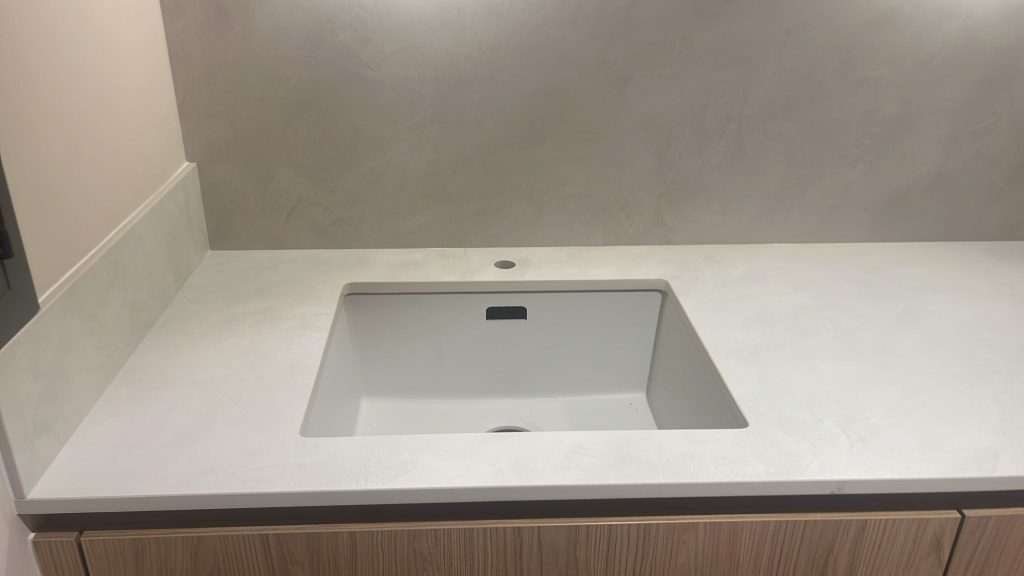
The great point in favor is evident: the surface is “continuous” and you can wipe it with a cloth and drag leftovers directly to the sink. In kitchens for daily use, this comfort is noticeable.
Yes indeed, success is on the edge. The countertop is exposed at the perimeter of the cut and that is where the material and finish rule.. At Marbres Barcelona we usually review with a magnifying glass the type of singing, sealing and support because a poorly resolved undercounter ends up causing war.
Pros of undercounter
- Easier to clean the work area: without rim.
- Modern finish and visually light.
- Allows the countertop to stand out, especially in natural stone.
Cons of undercounter
- The edge of the countertop is more exposed to shocks and humidity.
- Requires a good sealing and precise installation.
- If you choose a very deep breast or with little “wing”, can complicate access to staples/supports.
And the “white undercounter sink?”?
It is a beautiful option, but it is advisable to choose it wisely. a white sink (ceramics, composite, resin or quartz) can show faster lime marks, café, tea or sauces if not rinsed. The key is not to avoid white, but combine:
- Easy to clean surface (adequate finish and quality of material).
- Simple routine: Rinse and dry the perimeter so that the lime does not “cook”.
- Faucets and aerator that it does not splash more than necessary (reduces microdroplets around).
In our case, when someone wants a pristine white, We propose to see real samples and evaluate the use: A family kitchen is not the same as a kitchen where little cooking is done.. Seeing it in person in our showrooms helps a lot to decide without regrets..
Flush sink: the most “premium” if it is well executed
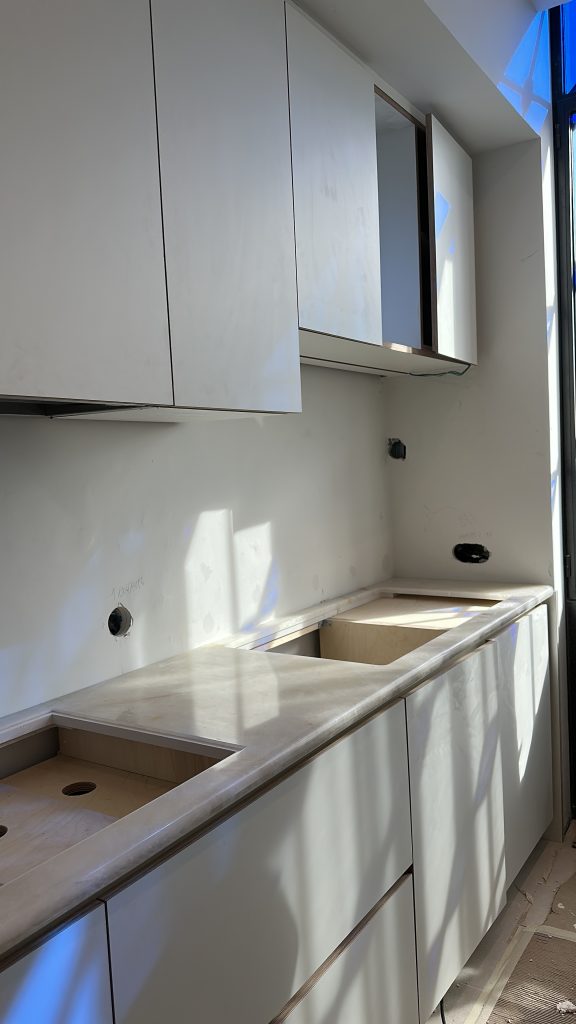
The flush design makes you fall in love because it maintains a continuous line and, both, protects the edge of the countertop from direct blows. Cleanliness is usually excellent: There is no step and the passage of the cloth is natural. But here there is a condition: the union must be perfect.
The typical risk is not that it becomes more dirty, but if the joint is irregular or the machining is not fine, a slot appears where debris accumulates. That's why, At Marbres Barcelona we prefer to consider it as part of a precision project: measurement, machining and assembly working as a whole.
Pros of screeding
- Very integrated aesthetics and high-end kitchen feel.
- Convenient cleaning if the meeting is well resolved.
- Good perimeter protection against “aggressive sweeps”.
Cons of screeding
- Demands more precision (and usually more labor/machining cost).
- If the joint is not fine, can become a black line over time.
- Not all sinks or countertops accept it equally well..
Countertop sink: the most practical for quick renovations
The countertop (embedding) It's the classic for a reason.: installs easily, It is usually cheaper and in “complication-free” renovations it is a very robust solution.. In exchange, the flange and the joint become the critical point: the dirt stays there if not cleaned frequently.
If you are concerned about visual hygiene, It doesn't mean you should discard it.. There are models with fine edges and shapes that are easy to review.. The difference is in choosing the design well and not falling into the typical mistake.: a wide rim with recesses that become a grease “magnet”.
Pros of the countertop
- Easier installation and versatile.
- Very good option when the furniture or countertop does not allow more technical solutions.
- Facilitates future replacements without touching the counter so much.
Cons of countertop
- The flange + silicone build up lime and fat more easily.
- Visually it can “cut” a main countertop.
- In daily cleaning, You cannot sweep debris directly into the sink without passing the step..
Countertop with integrated sink: when the union disappears
If you are looking for zero visible joints, there is another way: the countertop with integrated sink. Here the “sink” can be made of a material compatible with the countertop or an integrated solution (depending on system and material). The result is spectacular, especially in minimalist kitchens, because you reduce the connection lines to a maximum.
The important part is to understand that it is not always the best option for everyone.. In some cases the aesthetics are impeccable., but maintenance depends on the finish (matte/polished), of use and how the material responds to shocks, lime and products. With our clients, we usually assess whether they prioritize zero joints o resistance and easy repair in the day to day.
Which option fits best with marble and granite?
In natural stone, the type of installation is not decided just by taste. It is decided by the balance between aesthetics, resistance and real cleanliness. If you are choosing material, This logic can guide you:
| Installation type | Ease of cleaning | Dirt critical point | When it usually fits best |
|---|---|---|---|
| Under counter | Alta | Sealing and edge of the cutout | If you want to sweep debris into the sinus and a clean aesthetic |
| Flush | Alta (if it is well done) | Perimeter microjoint | If you are looking for a premium finish and visual continuity |
| Countertop | Media | Flange + silicone | Quick reforms, tight budgets or easy future replacement |
If you are evaluating a leading countertop, worth exploring options marble countertops, where the type of sink greatly influences how the grain and continuity of the whole is perceived.
And if your priority is off-road resistance, in granite countertops Undercounter or flush work usually works very well., always with impeccable machining and correct sealing.
Typical errors (those who then make it “dirtier”)
Many times it is not the type of installation, sino a bad detail decision. These are the mistakes we see the most when someone comes “tired” of cleaning:
- Low quality silicone the misapplied: darkens and traps dirt.
- Edges with recesses on countertop: difficult to review.
- Edge without good finish under counter: it is noticeable and degrades sooner.
- Not anticipating water: splashing faucet, absence of accessories and draining area.
- Aggressive products: harsh scouring pads or inadequate cleaners that leave the material visually more “porous”.
At Marbres Barcelona we insist on something very simple: Cleanliness begins in design. A well-resolved edge and a consistent choice of materials reduce daily “war”.
How to decide on 3 questions (without complicating)
If you want a practical decision, ask yourself these questions:
- What bothers you the most?? The darkening joint/edge or the fear of damaging the edge??
- How do you clean? Quick wipe or meticulous cleaning??
- what commands: aesthetics or resistance? if the countertop is the protagonist, integrate more; if functionality prevails, simplifies.
When you answer honestly, the option usually comes out alone. And if you also want the result to be perfect to the millimeter (songs, together, trimming and leveling), The safest thing is to present it as a complete project of custom countertops. In our team, That approach is the one that best guarantees that beauty is also easy to maintain with the passage of time.
In the end, “what gets dirtier” depends on where there is a step or a poorly resolved joint. If you prioritize quick cleaning, the undercounter usually wins; if you want the most integrated finish, flushing shines when well executed; and if you need a practical and replaceable solution, the countertop complies. The key is that the countertop assembly + sink is designed as a single piece: that's where you notice the difference.
