A well-sized countertop is noticeable every day: less back pain, more safety when cooking and a kitchen that “fits” with your habits. The key is not to memorize a number, but understand how to calculate height and depth according to your height, the type of tasks and the material (especially if you are looking natural stone countertops).
Countertop height: the standard and the really ergonomic
In most kitchens we work in a “standard” range because it fits with the furniture and appliances., but ergonomics goes one step further: the height should adapt to whoever cooks the most. If two people use it daily and there is a height difference, It is advisable to prioritize the main person and compensate with details (cutting board, anti-fatigue mat, distribution of tasks).
The most useful rule is simple: standing, with relaxed arms, The countertop usually works best when it is ca.. 10–15 cm below the elbow. This reduces stress on shoulders and lower back during food preparation., which is the most repetitive task.
elbow rule: measure from the floor to your elbow and subtract 10–15 cm. This result is an excellent starting point to decide the final height.
To land it quickly, here you have a reference by height (indicative):
| Height of the main person | Recommended countertop height (approx.) | When to go up or down 1–2 cm |
|---|---|---|
| Under 1,60 m | 87–90 cm | It rises if you knead a lot; lower if there is little shoulder strength |
| 1,60–1,75 m | 90–92 cm | Increase if you cook daily; go down if you prefer to work “close” |
| 1,75–1,90 m | 93–96 cm | Go up if you do a lot of preparation; low if the plate is high |
| More than 1,90 m | 97–99 cm | Especially suitable if there is a low built-in sink |
These figures serve as a guide, but in custom projects the decisive thing is the whole: plinth + low cabinet + countertop thickness + sink type + final leveling. At Marbres Barcelona we see it often: A kitchen can “meet the standard” and still be uncomfortable if everything doesn't add up correctly.
Depth (bottom) from the countertop: 60 cm, 65–70 cm and when to go further
The depth of the countertop determines work comfort and the feeling of spaciousness. The usual thing is to start from 60 cm because it matches the depth of many base modules and facilitates the integration of appliances. Even so, gaining surface area is increasingly valued: 65–70 cm It can make a difference if you cook a lot or need a real support area.
The ergonomic “stop” is not set by aesthetics, but the scope: If you have to stretch to clean or reach the bottom, that countertop becomes uncomfortable. That's why, when we expand background, It is also worth thinking about less invasive tall furniture, well-located plugs and a rear (dashboard) that does not steal useful surface.
As a rule of thumb, these settings usually work:
- 60 cm: compact kitchens, easy integration, budget plus content.
- 65–70 cm: more useful countertop, greater safety distance in front of the plate, “premium” feeling.
- 80–90 cm (islands/peninsulas): when working on both sides or integrating bar area.
If you are thinking of island, remember that depth does not go alone: you have to maintain comfortable hallways to open dishwasher, oven or drawers without collisions, and leave real space for two people to move at the same time.
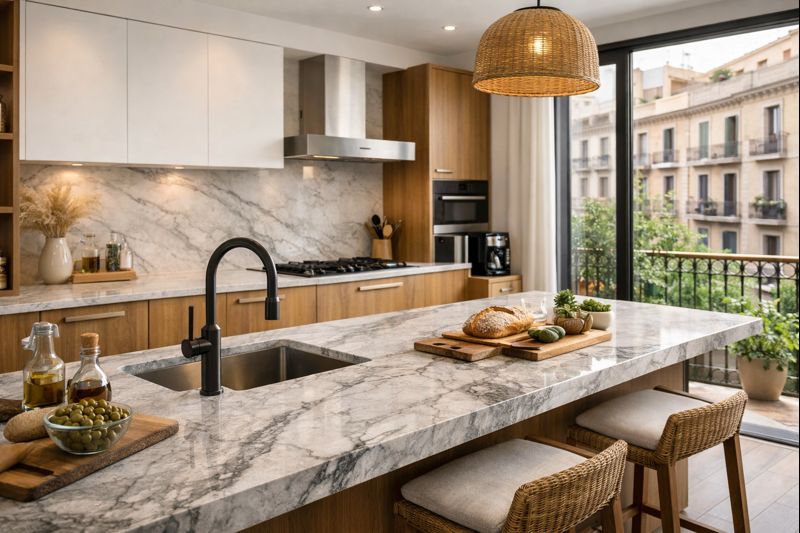
Thickness, flight and songs: measurements that change depending on the material
Thickness influences aesthetics, but also in the final height and resistance. In natural stone countertops (marble, granite, quartzite) It is common to work with thicknesses that transmit solidity and withstand daily use well.. Besides, if you are looking for a more robust effect, you can create a mitered edge (thick appearance) without triggering the weight on the entire piece.
The “flight” (what the countertop protrudes from the furniture) it also matters: a small flight improves comfort, but a large flight without support can be a problem. With natural stone, it is advisable to plan reinforcements and supports if there will be a bar, overhangs or areas with large gaps (undermount sinks, plates with wide cutouts, etc.).
Before deciding the thickness “by catalog”, think about these variables:
- Actual use: if you cook a lot, prioritize resistance, maintenance and practical edges.
- Sink type: under counter, flush or on countertop changes the finish and cleanliness.
- Together: better few and well located (never where blows fall, tensions or loads).
At Marbres Barcelona we usually recommend choosing the thickness and edge with a sample in front of you.: in the showroom it is understood instantly how light changes, the volume and perception of the material.
Heights “by zones”: preparation, cooking and sink
A kitchen is not a single task. Prepare food, cooking and washing have different gestures, and that is why in well-thought-out kitchens we play with microajustes. It is not always necessary to have a “two-level” kitchen., but it is advisable to understand the criteria to avoid decisions that later bother.
In general terms, the preparation area usually appreciates the standard ergonomic height, cooking can go slightly lower if the plate has its own height (tall pans), and the sink can thank a little more height so as not to stoop when scrubbing. If you can't vary heights, The solution is to prioritize the most frequent task and compensate with accessories and a good distribution.
Details that help without “complicating” the work:
- Stable cutting board If the countertop is a little high for you.
- Anti-fatigue mat if you spend a lot of time standing.
- Faucets and sink with real ergonomics: sinus depth, corner radius and ease of cleaning.
With our clients in Barcelona and surroundings, what works best is to decide first who uses the kitchen and how, and then determine measurements and materials with a technical visit.
Typical errors that make the work more expensive (And how to avoid them)
Most mistakes are not “big mistakes”, but small oversights that turn into last minute changes: more together, poorly placed cuts or a final height that does not match what was planned. The most common: choose furniture height without considering the actual thickness of the countertop and the type of installation (flush, skirt, pompadours).
Another classic is measuring on perfect planes when reality is not.. Walls out of square, sagging floors or unleveled furniture can cause tension. In natural stone, that tension is the enemy: what you are looking for is an installation with uniform supports and cuts designed to last.
Checklist of common errors:
- Do not prioritize the main user and end with a height “neither for one nor for the other”.
- Insufficient depth and always “fair” work area, especially if there is a robot, coffee maker or spices.
- Integrated appliances that do not fit the real background, vents or moldings.
- Sockets and dashboard poorly planned (They end up taking up the counter or becoming uncomfortable).
- Together where it doesn't belong: near a sink/hob or in areas of frequent impact.
- Unsupported cantilevers in bars or peninsulas, especially with stone.
If there is an idea that saves money, is this: The last measurement must be done with the furniture already installed and leveled. This step avoids most “surprises”.
How to take action without scares: checklist before manufacturing
Measuring a countertop is not just “length x depth”. There are cuts, finishes, unions, tolerances and aesthetic decisions that affect the result. To play it safe, The ideal is to prepare the project with a checklist and leave the final measurement to professionals., especially with natural stone for weight and precision.
At Marbres Barcelona we have state-of-the-art facilities and machinery, and that translates into a clear objective: that the piece fits the first time and that the finish is clean, durable and easy to maintain.
Before manufacturing, check these points:
- Assembled and leveled base units (includes definitive legs and sockets).
- Multi-point measurement if there are uneven walls (never assume that everything is square).
- exact location sink, plate, tap, plugs and accessories.
- Finishing solution (pompadour, frontal, seen sides, encounters with window).
- Meeting plan: where will they go and why (technique + aesthetics).
With all this clear, manufacturing is no longer a leap into the void and becomes a controlled process, with coherent decisions from the beginning.
Natural stone countertops: What do they provide and what to ask of the installer
Choosing natural stone is choosing character: each piece is unique. But in addition to aesthetics, the important thing is the practical: durability, stability and repair (depending on material and finish). In medium-high level kitchens and bathrooms, A good, well-installed natural stone adds real value to the home and ages with dignity.
As distributors and installers of different brands and materials, At Marbres Barcelona we usually approach it like this: first we define the use (family kitchen, designer kitchen, second residence), then the desired maintenance and, finally, the material that best fulfills it. That order avoids regrets and helps you invest where it really matters.: in the set.
If you are comparing options, always ask:
- real sample of the material (not just photo), ideally in lighting conditions similar to your kitchen.
- Explanation of finishes: pulido, apomazado, texturing and how it affects stains and cleaning.
- Detail of edges and joints proposed, with technical arguments.
If you are attracted to marble for its elegance, You can see options and finishes in our marble countertops, where we usually guide according to kitchen style and level of use.
And if your priority is to adjust measurements to the millimeter and resolve complex encounters (uneven walls, peninsulas, seen sides), The most efficient thing is to propose it as a complete project. custom made countertops. In practice, This decision is the one that most reduces typical errors and improves the final result..
A countertop is not just a surface: It is the place where cooking is done, you talk and live the house. When height and depth are well resolved, everything flows. If you are renovating in Barcelona or surrounding areas, The smart thing is to combine an ergonomic guide like this with a visit to the showroom and a professional measurement: the difference is noticeable for years.
